
INSTITUTE OF PHILOSOPHY OF NATURE
Author

Abstract
Diffraction and interference are traditionally assumed to have been caused due to the wave nature of light. Within the framework of modern physics, these phenomena are explained using electromagnetic wave theory and the principle of wave superposition. However, this explanation rests on a fundamental assumption that electromagnetic waves can propagate through empty space without any physical medium. From a commonsense physical perspective, this assumption raises important conceptual difficulties. All known wave phenomena of nature essentially require a definite role of material medium possessing appropriate elastic properties to sustain oscillations for transmission of energy. Further the wave concept of light has limitations in explaining rectilinear propagation, quantum-level interactions where light behaves as particles, most notably the photoelectric effect. It also fails to account for Compton scattering (or Compton effect), black body radiation and the discrete emission spectra of atoms. The notion of a wave existing without medium, therefore appears physically unrealistic and invites reconsideration of the assumptions underlying the wave description of light. Alternatively upgrade the reality-based particle concept of light to justify partial reflection, partial refraction, interference, diffraction and polarization. The limitations of any one concept (particle or wave) in explaining all phenomena of light led scientists to accept both the theories and used them as per convenience. It is also unrealistic to accept duality as a reality of nature. The present author considers the wave theory of light is purely hypothetical and has little stand in real sense, therefore he has augmented the light particle associating tiny mass in photonic mass unit, non-electric charge and mass-space structure which has helped in explaining the dynamics of constant velocity in a medium, reflection, refraction through conventional dynamics. The conventional interface of zero thickness in macro domain scale has significantly large thickness having a photonic charged polarised structure. The light particle carrying positive photonic charge is accelerated in the photonic field with increasing space potential and is decelerated with decreasing space potential within the interface. On the basis of the new concept this paper presents a conceptual justification for interference and diffraction of light.
Keywords: Interference and diffraction of light, Particle-based light model, Photonic charge and mass, Structured space medium, Field–particle interaction, Interface polarization effects.
Introduction
The historical development of wave optics originally included the concept of a luminiferous medium, but this idea was largely abandoned following the rise of modern electromagnetic theory. As a result, diffraction and interference are interpreted today as purely wave-based phenomena arising from the spreading and superposition of electromagnetic fields. Nevertheless, several aspects of these phenomena, particularly the formation of discrete fringe structures and their dependence on boundary conditions, may also be examined from an alternative perspective that does not rely on the existence of self-propagating waves in empty space.
In this article, diffraction and interference are reconsidered within a particle-based concept of light in which light consists of structured photonic particles possessing finite properties of mass in photonic mass unit, momentum and non-electric charge [1] [2]. In this framework, the surrounding space is not treated as an empty void but as a structured medium capable of interacting with moving photonic particles. The interaction between photons, boundaries, and the structured space medium can naturally lead to organized spatial patterns that resemble the fringe structures commonly attributed to wave interference.
The purpose of this work is therefore not merely to reinterpret classical optical phenomena but to explore whether diffraction and interference may arise from deterministic particle–medium interactions rather than the hypothetical wave superposition. Such an approach aims to restore a cause–effect description consistent with physical intuition while opening a possible pathway toward a more unified understanding of light and space.
Discussion
The reflection, refraction, diffraction, interference and polarization of light are surface related phenomena, hence understanding the surface (interface) of two media is of vital importance in addition to proper understanding of light particles and the medium in respect of their physical structure and properties such as the charge state for a clear conceptual understanding of the phenomena of light. In the new concept, particles of all domains have a centrally organized structure having a nucleus and extra nuclear space structure containing orbital particles at discrete distances. The extra nuclear space structure in any domain has a space density graded structure and contains space matter particles in equilibrium with the space structure due to mass-space attraction. The spatial density of space matter particles is directly proportional to the number density of space matter particles which can be visualized from the structure of the atmosphere of the earth. Beside the local neutrality of space structure, there exists a charge field structure within the extra nuclear space structure which is caused by the charge distribution within the core and crust of the particle. Due to different range and strength of charge interaction among charge particles of different domains, different nature of charges (electric and non-electric) interplay in different nature of field-particle interactions. The inter atomic space medium contains space matter particles of micro-micro domain (light particles) in neutral state as well as charge state similar to the existence of neutral atoms, ions and free electrons in the interplanetary space. The interface structure is primarily composed of a space medium containing micro-micro domain space matter particles (light particles) and there exists a charge polarised structure due to stiff photonic potential gradient between the interfacing mediums which causes different phenomena of light due to field-particle interaction.
Interference
An atomic particle would be found as a massless and structureless point particle in macro domain scale; however, the same atomic particle has nucleus and extra nucleus space structure with electron configuration in micro domain scale. Recently this author has explored the reality of light particles in micro-micro domain scale and suggested the existence of mass in photonic mass unit, non-electric charge in photonic charge unit and structure in photonic dimension scale [3]. In this new concept light particle is also a particle of matter of micro-micro domain which is one domain below the atomic domain. The physical existence of light particles in space medium gives a new connotation of the space/vacuum medium as photonic gas. The particle-particle interaction, field-particle interaction and field-field interaction have unified significance in micro domain and micro-micro domain. A charge particle ‘A’ of one domain forms a charge field in its surrounding medium and the charge field is formed by space matter particles of finer domains having gradient of state properties. Likewise, a second charge particle ‘B’ forms its charge field in the medium by the finer domain particles. If particle ‘B’ comes closer to ‘A’ then the field of ‘B’ superimposes on the field of ‘A’ where the structure of the field within the zone of intersection is reorganized by rearrangement of active space matter particles of finer domain. The interaction causing reorganization of stricture in the zone of intersection can be described in different ways as particle-particle interaction, field-particle interaction and field-field interaction. Thus, the significance of field-field interaction is otherwise the collective interaction of space matter particles in finer domains belonging to different fields. Hence, it is not required to presume that a field is a fundamental entity of nature since field interaction is otherwise the collective interaction of particles in finer domain.
The very existence of micro-micro particles (light particles) in different active states (non-electric charge state) has their placement in macro structure, micro structure of matter and the structure of space medium/vacuum medium. Thus, an active light particle carrying photonic charge when transits through a space medium, some of the active space matter particles in its closer proximity interacts with the transiting light particle. By this interaction the transiting light particle would respond to interaction with space matter particles of the medium (field) thereby undergoing acceleration, deceleration and change of direction. The space matter particle forming field also undergoes dynamic fluctuation due to the transit of the light particle. Another light particle passing close to the fluctuating field particles, responds to the fluctuation which causes interference of light. Spreading of light beams is caused due to interference.
Diffraction
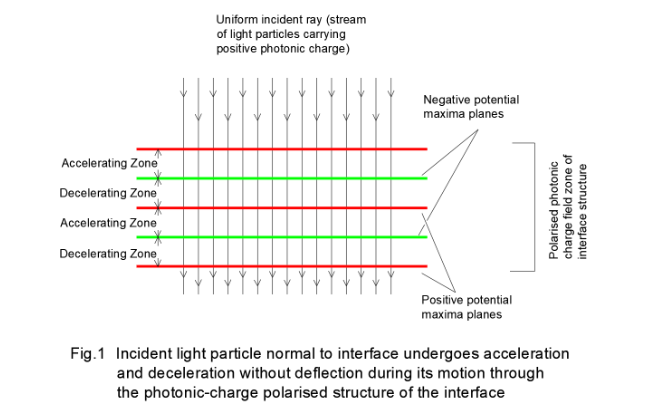
The role of interface structure in reflection, refraction and grazing of light has been discussed elsewhere [4] [5]. The diffraction phenomenon of light is caused due to field-particle interaction within the photonic charge polarised structure of the interface. Light passing close to sharp edges moves through the interface structure where bending of light (diffraction) occurs. Positively charged light particles are accelerated in the photonic charge field with decreasing photonic space potential and decelerated in the increasing space potential. Light particles moving along the field direction (normal to the surface /interface) experience strong field-particle interaction and the particles undergo acceleration and deceleration depending on decreasing or increasing space potential of the field (Fig. 1).
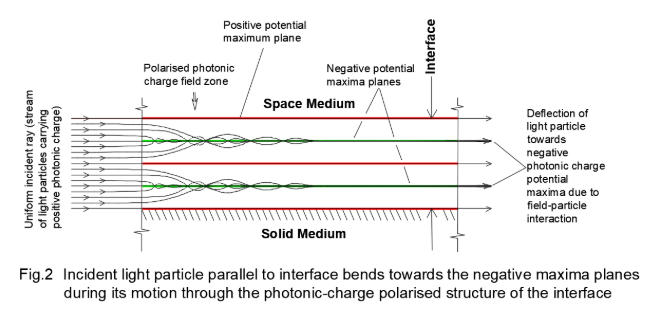
Light particles moving parallel to the surface/interface essentially moves along equipotential planes between positive and negative potential maxima where the light particle is gradually pulled towards the negative potential maxima as shown in (Fig-2). When it reaches the negative potential maximum, it finds the field is zero but the particle continues to move against the opposing field due to inertia of motion. Subsequently, the velocity component normal to the interface becomes zero. The light particle makes up and down motion a few times before it stabilizes its position in the negative potential maximum plane (Fig.2). All light particles between two potential maxima are dragged to the negative potential maximum.
In the new concept the extra nuclear space structure of an atom is formed due to mass-space attraction. The space density of extra nuclear structure decreases outwardly due to the inverse square law of mass-space attraction. Thus, the size of the atom is a function of background space density which in turn is a function of the number density of space matter particles. Within the extra nuclear structure, a number density of space matter particles goes on increasing towards the nucleus. Thus, the size of the extra nuclear space structure of space matter particles decreases towards the nucleus. Hence, the space holding per unit of mass of a space matter particle goes on decreasing towards the atomic nucleus. In the new concept charge (electric and non-electric) is a state property of matter (mass-space integral system) characterised through the mass-space in matter relative to the mass-space ratio of matter in its background. In a given background if all matter has the same mass-space ratio (same space holding per unit of matter) then they are neutral to one another and each matter or their assembly can be considered to have zero charge potential in a relative scale. Any one space matter particle or their cluster is a neutral matter carrying zero charge in the relative charge concept. Another space matter particle with a different space holding per unit of mass entering to the neutral environment is characterised to carry charge with reference to the zero-background potential. Conventionally a mass rich particle (less space holding per unit of mass) carry positive charge and a space rich particle (more space holding per unit of mass) carry negative charge. Following the absolute scale of charge, all particles in all states and in all domains have an absolute value of charge due to its mass space ratio where the pure space without mass relates to zero absolute charge potential and the potential goes on increasing with the increase of matter content per unit of space content. Thus, the inter atomic space in solid contains mass rich space matter particles and that of space medium contains space rich space rich space matter particles. Hence, the inter atomic space potential (photonic charge potential) of solid and liquid is much higher than that of gas or space medium. Hence, the interface zone facing solid at one end and space medium at other end has a high order of potential difference. The interface is composed of mostly micro-micro domain particles (light particles) and for a di-photonic interface structure, polarization features are inevitable. One can visualize from the natural polarised electric structure of the atmosphere of the earth starting from the surface.
Bending of light near sharp edges
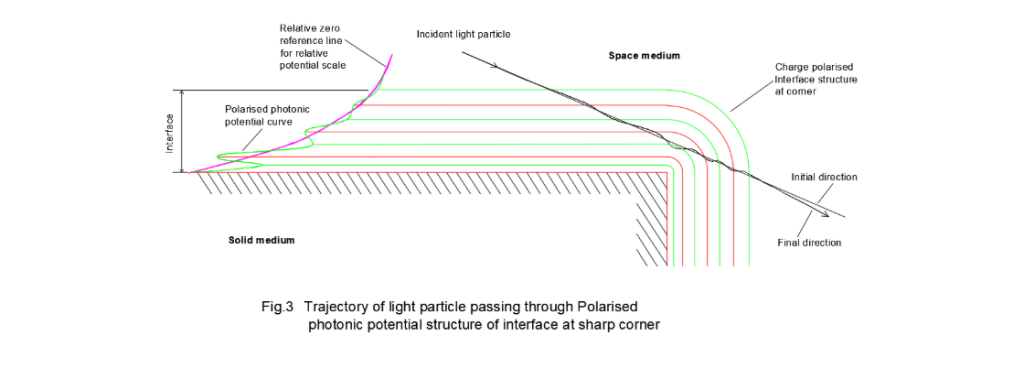
The equipotential planes of the interface are parallel to the surface. A sharp edge in the form of a line is formed when two surfaces meet. But the equipotential planes of the interface don’t form such a sharp line as it takes a smooth curve at location of corners and the radius of curvature increases outwardly as shown in Fig.3. There exists a photonic charge potential gradient within the interface with high potential corresponding to charge state of photons within the inter atomic space of solid and the low potential corresponding to the charge state of photons in the space medium adjacent to the interface. The potential gradient is stronger near the solid surface and weaker towards the space medium. The degree of photonic charge polarization of the interface medium is high at the near end of the solid surface and reduces to zero at the far end from the solid surface. In order to express the polarised potential within the interface, a relative potential scale is used with a dynamic reference zero line as shown in Fig.3. With reference to the relative photonic charge potential scale the positive and negative maxima planes of the interface are shown in red and green lines respectively.
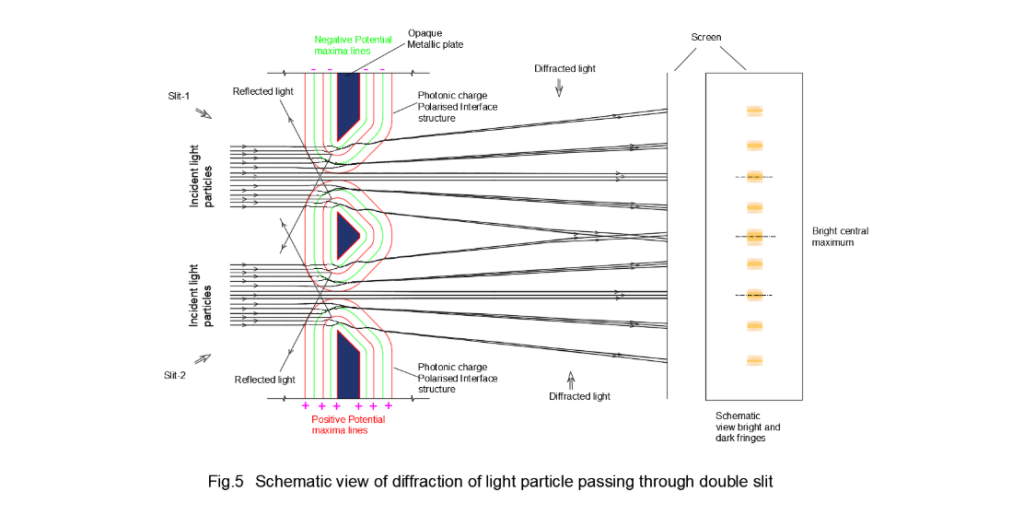
Incident light particles passing close to the corner of a solid, though have clear access without intervention with the solid structure but are intercepted by the photonic field structure of the interface. During the transit of light particles close to the corner, the light particle is accelerated and decelerated as it crosses the decreasing potential and increasing potential zones of the polarised field respectively. Thus, the gross field effect of the interface on the light particle changes the rectilinear trajectory causing bending of light at corners (Fig.3).
Diffraction of light passing through single slit
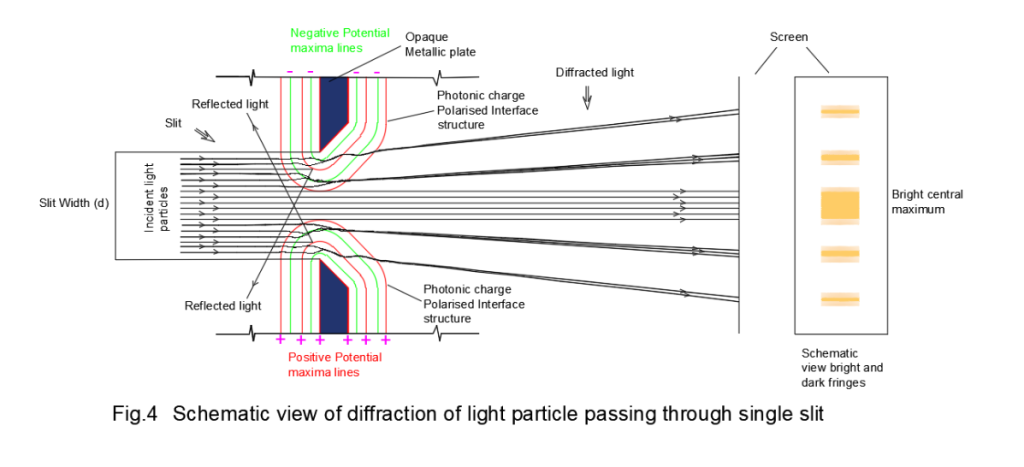
A slit is a thin rectangular opening in macro domain scale which has large dimension in micro-micro domain scale having photonic charge polarised structure at the edges of the slit as shown in Fig.4. The slit across the narrow opening has three important zones. The two zones correspond to the interface structures of two sharp edges of the opaque metallic plate providing the slit. The third zone corresponds to the middle portion of the slit beyond the interface structure. Light passing through the third zone is not affected by the photonic field of the interface while the light passing through the interface zones of opposite edges undergo acceleration and deceleration by field-particle interaction in the decreasing potential and increasing potential of the photonic polarised field fields. Light particles passing through different zones of the slit exhibit different distinct phenomena where the light particle passing through the middle zone (third zone) reaches the screen unaffected and the light particle passing through the first and second zone are diffracted. This forms images on screen having a bright central zone with fringes on both sides (Fig.4).
Diffraction of light passing through double slit
There is nothing special in double slit experiment other than the considerations made in single slit. In case of a double slit the fringes produced by the two slits overlap in the central zone which magnifies the intensity of fringe at the center. The mismatch of fringes produced by two slits are reorganized to a single fringe pattern by the surface charge-field effect of the screen. The increase of brightness at the center of the image produced by double slit is shown in Fig.5.
Conclusion
The unrealistic wave theory of light was accepted as a reality of nature when it explained the diffraction of light which the realistic particle concept failed to explain. Both particle and wave concepts of light became indispensable. This made scientists believe that duality is a reality of nature. But nature is always consistent with its norm. The author attempted to remove the unnatural wave concept of light since the very light wave without a medium is not feasible and he has successfully explained many phenomena of light using the particle concept. Here again, in this paper, the author has explained the diffraction phenomena of light through the realistic particle concept. The new understanding of different phenomena of light has a bright scope to remove erroneous concepts of dual nature of light and establish consistency of nature in all its fronts.
Reference
- https://philosophyofnature.org.in/towards-a-new-comprehensive-universal-science.
- https://philosophyofnature.org.in/new-concept-of-electric-charge-in-matter.
- https://philosophyofnature.org.in/different-domains-of-nature.
- https://philosophyofnature.org.in/micro-micro-structure-of-interfaces-and-photonic-charge-field-a-reality-based-classical-explanation-of-reflection-and-refraction-of-light.
- Grazing of light, Article-1, Issue-2, Volume-4, Towards Unifications of Sciences.