
INSTITUTE OF PHILOSOPHY OF NATURE
Author

Abstract
The phenomenon of grazing incidence of light is conventionally explained within the framework of electromagnetic wave theory, where boundary conditions naturally lead to wave alignment along an interface at shallow angles. However, the wave description raises fundamental concerns regarding the propagation of light in the absence of a tangible medium, as wave phenomena typically require a medium possessing suitable elastic properties. In contrast, the particle concept of light offers a more physically intuitive basis, as particles can propagate through a medium without dependence on its elastic characteristics.
The dominance of wave theory, largely due to its success in explaining certain optical phenomena, has led to the acceptance of wave–particle duality as an intrinsic quality of nature. This work challenges the duality standpoint by emphasizing the particle model, particularly when it has a satisfying explanation for rectilinear propagation, reflection, refraction and the photoelectric effect. Building upon earlier studies, the author introduces an enhanced particle framework incorporating finite mass, non-electric charge (photonic charge) and a structured mass–space interaction (field-particle interaction) within the interface medium. Within this perspective, the present paper develops a unified physical mechanism to explain the grazing behaviour of light. The proposed model aims to provide a coherent, causally grounded alternative to wave-based interpretations, with the potential to account for a broader range of optical phenomena without involving duality.
Keywords: Grazing incidence of light, Particle model of light, Photonic charge, Interface polarization, Field–particle interaction, Micro-micro domain dynamics.
Introduction
Light exhibits different phenomena (rectilinear propagation, reflection, refraction, grazing, diffraction, interference, polarization, photoelectric effect, constant velocity in a medium etc.). This author fails to accept the feasibility of propagation of light waves in vacuum medium without having the required wave propagating properties and provides alternative justification in support of the particle concept of light [1]. The author has further argued on the existence of a tiny mass of photon in the photonic mass unit (micro-micro domain mass unit) the magnitude of which is zero in atomic mass unit [2]. Further, the light particles carry non-electric charge which has interaction in micro-micro domain range [3]. Thus, in the new concept, light as a particle of matter having mass, charge and internal structure in micro-micro domain scale has scope in exploring justification for different phenomena of light. The physical existence of light as a particle of matter introduces new physical perception of vacuum/space. The additional features of light particle and medium have scope to overcome the limitations of the corpuscular theory in explaining different phenomena of light. The dynamics of reflection and refraction has been explained from the above concept of light [4]. The new concept of light being closer to reality, has a bright scope of explaining diffraction, interference and polarization phenomena of light. The structure of light particles also has similarity with the structures of the atomic particle, solar system and galactic system in having nucleus and extra nucleus space structure due to mass-space interaction [5]. The new structural concept of light particles and the medium provide justification for the different constant velocities of light in different mediums including the maximum velocity in vacuum/space medium [6].
Discussion
The gaseous state of matter is conceptualised through the presence of atomic, molecular and sub-atomic particles in space medium. The perception of the existence of matter in finer domain (micro-micro domain) and their presence as space matter particles in space/vacuum medium gives rise to the revised understanding of space/vacuum as photonic gas. The organized pattern of micro-micro particles of matter in neutral and charge states go to form the structure of electric field in space medium hence we may not have to assume that field itself is a fundamental entity of nature. The new concept of light particle and the new concept of space medium enable classical physics to deal with different phenomena of light through conventional dynamics.
The grazing phenomenon is not confined to light particle (micro-micro particle) alone. In micro domain grazing of incident of electrons, ions and atoms on surfaces occurs at very shallow angles leading to surface channeling. In the macro domain, the grass cutter shot of football resembles the phenomenon of grazing where the ball undergoes skimming or just above the turf. Thus, the phenomenon of grazing is common to micro-micro particles (light particle), micro particles (electrons, ions and atoms) and macro bodies such as football. The best way to conceptualizeα the mechanism of grazing of light is to analyse the grazing of a football. The football hitting the ground at shallow angle (α) has two velocity components, 1) c sin , normal to the surface and 2) c cos , parallel to the surface. The normal component of velocity makes the football rebound. However, the rebound velocity is reduced due to loss of energy in partial inelastic impact and windage. On the other hand, the parallel component of velocity is gradually reduced by friction and windage. The drop in the vertical component of rebound velocity is conveniently accounted for by the coefficient of restitution. An elastic ball dropped from a height H never reaches its original position after rebound because the collision is not 100 percent elastic. The ball bounces on ground again and again, each time with a reduction of its rebound velocity and finally comes to rest. Similarly, the vertical component of the football hitting at shallow angle becomes zero after a few bouncing. The horizontal component experiences frictional resistance from ground during contact period. The frictional resistance acts tangentially on the contact surface of the ball whereas the inertial force acts at the center of mass of the ball thus producing a turning moment to roll the ball. A part of the linear kinetic energy of the ball is converted to rotational kinetic energy due to mass moment of inertia. Thus, due to the lack of 100% elastic collision, the bouncing of football on ground gradually reduces its amplitude and finally approaches zero. Thereafter, the ball only rolls and finally comes to rest due to rolling friction and windage. But light particle maintains a constant speed in a uniform medium due to a different mechanism discussed elsewhere [6]. However, the velocity of light undergoes acceleration and deceleration in the highly polarised photonic charge field structure within the interface.
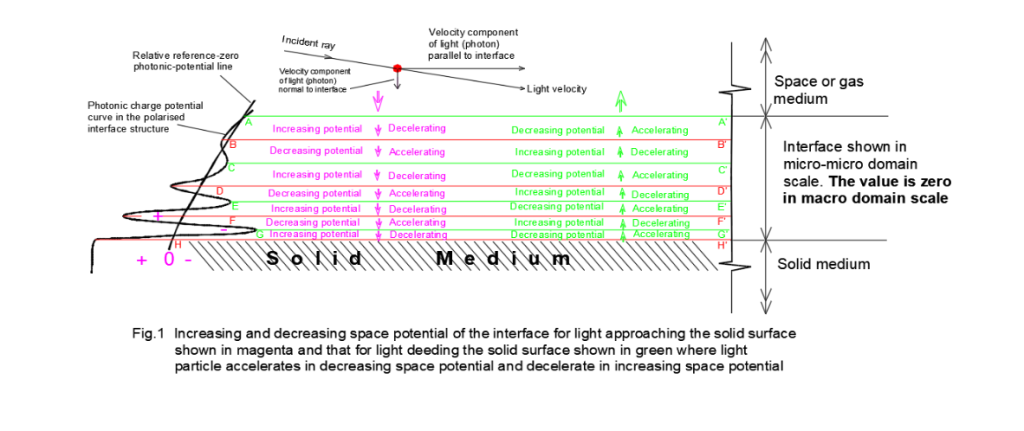
The surface of dense medium (solid/liquid) facing the less dense medium (gas/space medium) forms an interface between the mediums spreading over few atomic dimensions significantly towards the lighter medium [4]. The interface structure is primarily composed of micro-micro domain matter. The photonic charge potential difference across interfaces causes charge polarization within the di-photonic interface medium similar to electric charge polarization in a di-electric material. The polarized photonic charge-field originates from high inter atomic space potential of dense medium and gradually slows down within the interface which becomes remarkable in micro-micro domain scale. A positively charged light particle in its transit through interface undergoes acceleration and deceleration of its normal component (the component, perpendicular to the interface) due to increasing and decreasing photonic potential of the charge polarised field. A positively charged photon carrying photonic charge accelerates towards decreasing photonic space potential even when the charge-potential gradient is caused by charge polarization. However, the acceleration is modified (weakened) in a polarised field. Thus, the normal component of velocity of light particle carrying positive photonic charge is accelerated in the direction of decreasing photonic potential and is decelerated in the direction of increasing photonic potential within the photonic charge polarised interface medium. The photonic charge field (potential gradient) is zero at photonic charge potential maxima and minima. A light particle approaching a positive potential maximum overcomes the photonic charge field barrier by utilising its kinetic energy thereby its normal component of the velocity is gradually reduced. If the perpendicular component of kinetic energy, possessed by virtue of its velocity component normal to interface is enough to overcome the barrier of photonic potential maximum, then it would enter into the different photonic field with decreasing potential where the light particle would be accelerated up to the point of negative potential maximum. The photon particle once again finds a field with increasing potential where it loses its kinetic energy due to opposing field effects. If a light particle has enough energy, then it would as well cross over the second field barrier. Light at any angle of incidence could have obeyed the laws of reflection since the field conditions under acceleration and deceleration of the normal velocity component is identical for the incident path and the reflected path. But there is always loss of energy due to unevenness of the field within the interface. The magnitude of the vertical component of velocity of light particles approaching the interface at a shallow angle being very small, the directed kinetic energy normal to interface is also very small and the loss of energy in rebound becomes significant. In such a case the normal component of reflected light doesn’t have enough energy to overcome the field barrier in its reflected path which makes the light particle to undergo back and forth motion around the plane of negative maximum potential, each time reducing its amplitude. Finally, the light particle moves parallel to the interface along the equipotential plane along the negative maximum potential plane which results in the grazing effect of light.
The grazing mechanism of light is now described in relation to figure for easier understanding. Figure-1 shows the schematic view of the photonic potential structure within the interface between solid medium and space medium. The inter-atomic space potential (photonic charge potential) within the solid is much higher than the space potential of the space medium. The cross-section of interface medium shown in micro-micro scale identifies the equipotential planes at potential maxima and minima marked as planes A-A’, B-B’, C-C’, D-D’, E-E’, F-F’, G-G’ and H-H’. The planes B-B’, D-D’, F-F’ and H-H’ correspond to potential maxima and the planes A-A’, C-C’, E-E’ and G-G’ correspond to potential minima. A light particle carrying positive photonic charge approaching towards the solid surface (plane H-H’) finds the increasing space potential in its journey from A-A’ to B-B’, C-C’ to D-D’, E-E’ to F-F’ and G-G’ to H-H’ where the velocity drops gradually due to the conventional field particle interaction. And during the transit of the said light particle from B-B’ to C-C’, D-D’ to E-E’ and F-F’ to G-G’ the velocity gains due to field particle interaction in a decreasing space potential. On the other hand, any light particle coming through solid medium or reflected from H-H’ plane crosses the photonic polarised structure of the interface in its way to space medium. The photonic charge field with increasing potential for a photon’s transit from space medium to solid medium becomes a field with decreasing potential for the photon transiting from solid medium to space medium. Similarly, the photonic charge field with decreasing potential for a photon’s transit from space medium to solid medium becomes a field with increasing potential for the photon transiting from solid medium to space medium. The light particle travelling from space medium to solid medium or solid medium to space medium undergoes acceleration and deceleration in different layers of potential structure of the interface due to different nature of field particle interaction.
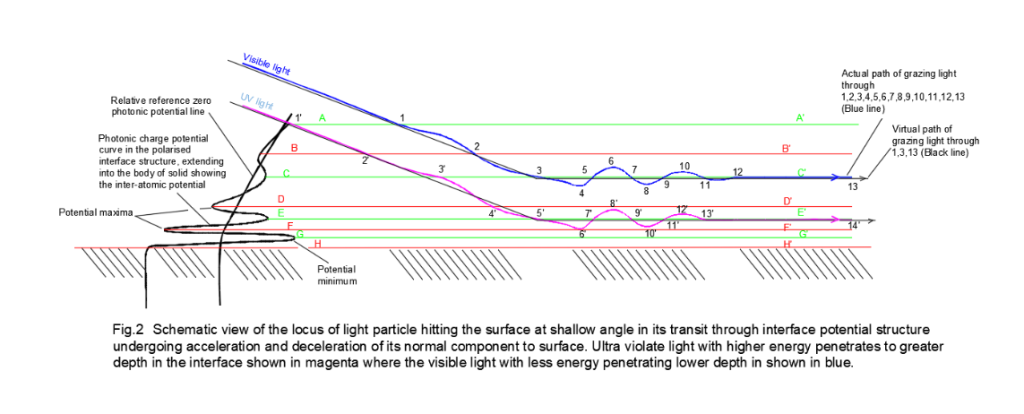
The light particle entering the interface at shallow angle passes through the polarised photonic potential structure of the interface where the normal velocity component stabilizes at one of the minimum potential planes depending on the energy level (charge state) of the light particle. The mechanism of the grazing of light at two different energy levels is described in Fig.2. The light particle with lower energy level and lower magnitude of velocity component normal to the interface and stabilizes at some outer negative potential minimum plane whereas that with higher energy level penetrates deeper and stabilizes at some inner negative potential maximum plane. The locus of two incident light particles (visible and UV light particles) at different energy levels are shown separately. The particle of visible light carrying positive photonic charge meets the outermost negative maximum potential plane of the interface at point ‘1’. The light particle travels from point-1 to point-2 in an increasing photonic space potential zone where the normal component of velocity is reduced by field particle interaction. The reduction of the normal component of velocity associates changes in magnitude and direction of resultant velocity and the same is shown schematically in the locus from point-1 to point-2. The light particle travelling from point-2 to point-3 experiences a gradual decrease of space potential where the normal velocity component of the light particle is increased thereby affecting the locus. Beyond the point-3 the light particle enters a field zone with increasing space potential and the normal velocity component of the light particle once again starts reducing and at point-4 becomes zero. Thereafter the light particle is accelerated in the reverse direction up to point-5 in the decreasing photonic space potential due to field particle interaction. At point-5, the field is zero but the particle continues to move beyond, against the field of increasing space potential and the velocity becomes zero at point-6. Thereafter the particle oscillates a few times across the negative maximum field potential with gradually decreasing amplitude and finally stabilizes its locus within the negative potential maximum. Hence, the locus of the light particle passes through points 1-2-3-4-5-6-7-8-9-10-11-12-13. In a similar manner the UV light also grazes by passing through 1’-2’-3’-4’-5’-6’-7’-8’-9’-10’-11’-12’-13’-14’.
Conclusion
Any realistic physical phenomenon is expected to have a realistic physical basis for understanding the phenomenon. Despite the mathematical merit of the wave theory of light, it lacks the very feasibility of the wave without a tangible medium. On the other hand, the particle concept of light though realistic but it lacks realization of mass and non-charge in finer domain, a domain below micro domain. The new perception of matter value and non-electric charge in light particles (particles of micro-micro domain) renders new scope for conventional dynamics in explaining different phenomena of light. The revised concept of the light particle and the new structure of medium have helped in understanding reflection, refraction and the constant velocity of light. This paper gives a clear picture, how the macroscopic concept successfully explains the grazing phenomena of light. If the particle concept of light is the only reality, then it can as well explain the remaining phenomena of light. If this is possible then we may not have to assume that duality is a reality of nature.
Reference
- https://philosophyofnature.org.in/critical-analysis-on-physical-reality-of-light.
- https://philosophyofnature.org.in/towards-a-new-comprehensive-universal-science.
- https://philosophyofnature.org.in/electric-and-non-electric-charges-and-their-inter-conversion.
- https://philosophyofnature.org.in/micro-micro-structure-of-interfaces-and-photonic-charge-field-a-reality-based-classical-explanation-of-reflection-and-refraction-of-light.
- https://philosophyofnature.org.in/mass-space-structure-of-centrally-organized-systems.
- https://philosophyofnature.org.in/a-new-vision-of-light-and-space-the-cause-behind-constant-velocity.