
INSTITUTE OF PHILOSOPHY OF NATURE
Author

Abstract
The particle-based concept of light presents itself as a physical process in the reality-oriented framework. In contrast, the conventional wave description of light particularly in the absence of a tangible propagation medium raises fundamental conceptual concerns and may be regarded as hypothetical in nature. A natural question arises: if the particle concept of light reflects physical reality, why does it struggle to adequately explain key optical phenomena such as constant velocity, refraction, diffraction, interference and polarisation? The limitation, however, does not necessarily lie in the particle concept itself, but rather in the oversimplified characterization of light particles as a structureless entity. When light is treated merely as a massless, chargeless point-like quantum of energy, essential parameters such as internal structure, intrinsic properties and interaction mechanisms are neglected factors that may play a decisive role in governing optical phenomena. In the proposed framework, light particles are not abstract quanta but entities belonging to a micro-micro domain of matter possessing finite mass (expressed in a photonic mass unit), non-electric form of charge (quantified in a photonic charge unit) and having internal structure comprising nucleus and extranuclear space structure, analogous in principle to atomic systems. Just as an atom is ionized by loss of electrons when excited in excess of ionization potential, a light particle moving at high velocity is postulated to lose negatively charged sub-photonic constituents from its orbital structure. As a result, light particles in motion carry a net positive photonic charge. The propagation medium is also re-envisioned as a structured entity composed of space matter particles spanning multiple domains, existing in both neutral and ionized states. This medium is capable of supporting distinct, mutually non-interacting charge fields including both conventional electric fields and non-electric (photonic) charge fields similar to those observed in the Earth’s atmosphere and ionosphere. Light particles, endowed with photonic charge, interact dynamically with the photonic charge fields of the medium through field-particle interactions. The naturally existing charge field in a homogeneous medium is largely inconsequential. However, at interfaces of different mediums, strong photonic potential gradients emerge, leading to highly polarized charge structures. The zero thickness of the interface in the macro domain scale becomes significantly large when expressed in the micro-micro domain scale, allowing a meaningful dynamic of the light particles within the interface medium.
Within this conceptual framework the author has already justified the fundamental optical phenomena including constant velocity, reflection, refraction, grazing incidence, diffraction and interference through consistent physical mechanisms. Following the new concept of light particle and the medium, the present work addresses the phenomenon of polarisation and proposes a coherent mechanism for the scattering of light.
Keywords: Polarization and scattering of light, Structured particle model of photons, Photonic charge dynamics, Sub-photonic particles (pholetrons), Field–particle interaction in medium, Interface-induced charge polarization.
Introduction
The interaction of a particle with a medium is a function of the structure and state property of the particle as well as those of the medium. In the new concept light particles (photons) have nucleus and extra-nuclear space structure with space matter particles and orbital particles (say pholetrons) Fig.1. The newly proposed terminology of pholetrons in photonic structure has similarity with the electron in atomic structure. The light particles carry absolute photonic charge by virtue of non-equilibrium mass-space association [1]. The local charge state of a medium though has an absolute value but is considered zero in relative scale for local charge activity of light particles. A light particle having the absolute potential same as the local space potential of the surrounding medium behaves neutral to the space matter particles of the medium. A light particle carrying charge at higher absolute potential than the absolute charge potential state of the medium is considered as positively charged photon and that carrying charge at lower absolute potential than the charge potential state of the medium is characterised as negatively charged photon in a relative charge potential scale where the absolute charge state of the medium is taken as zero. A photon at zero relative charge potential with reference to the charge potential of the local medium is in neutral to the local medium which is erroneously characterised as neutral matter in absolute sense. The so-called zero potential of neutral matter has a definite absolute charge potential and different relative charge potentials in different relative scales having different reference zero potentials. The above charge characterisation and the concept of neutral particles apply equally to electric and photonic charges in their respective domains [2]. A positive charge potential of one relative scale may become negative in another relative scale and vice versa, however, the absolute charge potential is always positive. The dimensional ranges of different charge interactions are different hence one type of charge doesn’t interact with another type of charge. A space medium associated with a celestial body contains space matter particles of different domains, hence different types of charge fields such as electric, photonic etc. are feasible in the atmosphere of a celestial body [3]. But the space medium of inter atomic space doesn’t contain electric charge bearing micro particles. A space medium in macro scale can have many varieties of charge field present in it and the fields in space medium can interact preferentially with the charge particles of different domains carrying different nature of charge. The electric charge field formed by photonic charge particles (micro-micro domain particles) carrying photonic charge and the photonic charge field is formed by micro-photonic charge particles carrying micro-photonic charge. In view of the above, a space medium/ vacuum, devoid of known form of matter, contains space matter particles of finer domains with multiple charge fields present in it. Any one aspect of study of the space medium introduces erroneous concepts of the space medium. Lack of perception to particles of finer and finer domains and the presence of different nature of charge fields compels one to make abrupt quantum assumptions on the features of particles and the fields as the fundamental unit of existence in nature. Thus, the physical perception of one type of particle or one type of field in a medium lead to an aspect-based conclusion of the reality and not the comprehensive reality of nature. This is something like the well-known story of perception of an elephant gained by six blind persons by touching different parts of the elephant.
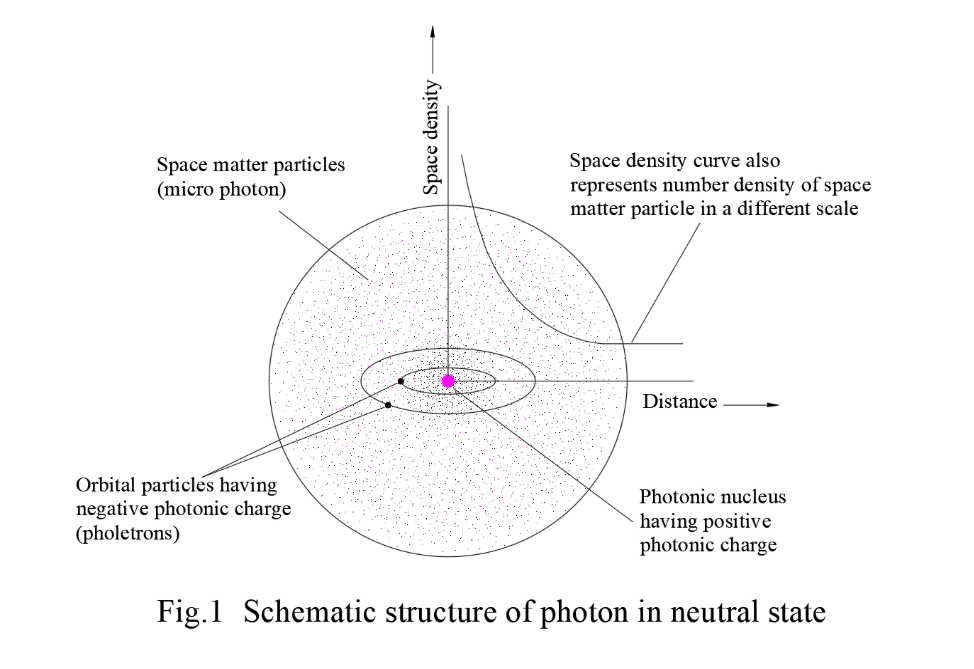
The nucleus of a light particle carries positive photonic charge and the orbital pholetrons carry negative photonic charge. A photon at rest or in slow motion is in neutral state since the positive charge of the nucleus is equal to the collective negative photonic charge of the pholetrons. The neutral photon can be ionized by attachment or detachment of negative charge particles (pholetrons). The light particle at the speed of light has kinetic energy in excess of ionization potential where few pholetrons are detached from its extra nuclear space structure. The loss of pholetrons from extra nuclear space structures makes the light particle positively charged. Thus, the light particles are always positively charged in their motion through a medium except their transit through the interface where both types of ionic states of photon are feasible due to increase and decrease of velocity. The positively charged particle when passing through the charge polarised interface structure experiences a different nature of field-particle interaction.
Discussion
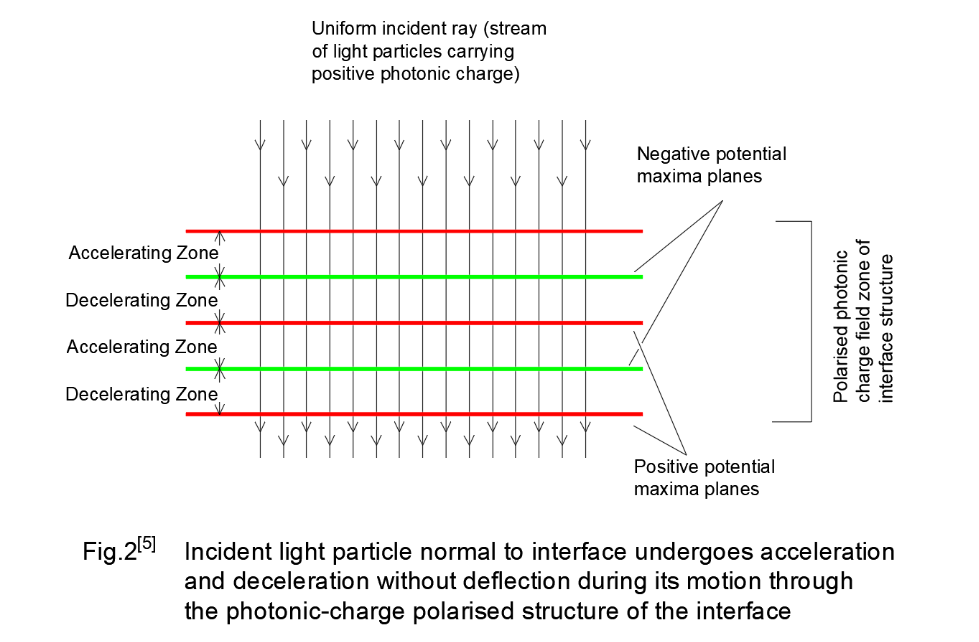
An examination to the atmosphere of the earth reveals that any local pocket of the atmosphere mostly contains neutral atoms (atoms at same absolute charge potential as that of the space potential of the locality), however, the space medium also contains charge particles (ions and free electrons of different number density depending on the levels of the atmosphere) [4]. The extra nuclear space structures of atoms and molecules as well as the inter atomic/inter molecular space contains photons in neutral and charge states. The photons within the extra nuclear space structure of the atoms/molecules remain in bound state whereas the photons present in inter-atomic/inter-molecular space are free photons in neutral and charge states. The micro domain space matter particles (molecular, atomic and sub-atomic) are nearly absent in vacuum and space medium but the said medium is full with particles of micro-micro domain and below. Like the presence of electric charge particles in the atmosphere of a celestial body, the space and vacuum mediums also contain non-electric ionic particles of finer domain. The gradient of the number density of different ionic particles in a medium justifies the presence of electric and non-electric charge fields in it. A light particle (positively charged photon) while passing through a medium interacts with the standing potential structure of the medium where its trajectory continuously changes its direction due to local interaction. The extent of field-particle interaction is a function of the duration of spatial exposure-time. A high-speed charge particle travelling through a field has less exposure to field particle interaction due to small spatial residence time and a slow speed charge particle moving through the same field experiences prolonged spatial interaction due to longer exposure. The light particle carrying positive charge is accelerated and decelerated in the medium depending on the nature of the field Fig.2 [5]. Photonic charge field is invariably present in the charge polarised interface structure. Positively charged photons are decelerated in a photonic charge field with increasing potential. If the field barrier is strong enough, the kinetic energy of a light particle (photon) gets fully utilized before completely overcoming the field barrier where the velocity becomes zero. Thereafter, it moves backward due to the reverse nature of charge potential gradient as it happens in reflection [6]. For transmitted light, the velocity of the light particles undergoes speed reduction where the residence time of light particles in a spatial location in the field is increased at decreased speed. In reflection of light, when the velocity of a light particle approaches zero, the light particle gets plenty of opportunity to capture sub-photonic particles (pholetrons) carrying negative photonic charge thereby attaining different ionic states. In case of transmitted light, the light particles overcome the field barrier and enter into the second medium, however the velocity of light particles is reduced. The low velocity points are also prone to attachment of negatively charged sub-photonic particles (pholetrons) and the change of charge state of light particles. The emergent light particle from a polarizing transparent medium has a different charge state than that of the incident light particle due to the said attachment process. Charge polarisation of light particles is feasible subject to availability of free charge particles in the medium. Polarisation of light particles is also feasible by orientation of spin direction.
Factors promoting attachment of charge particles with positively charged photon in charge polarisation of light
Light particles have very-very small dimensions therefore, head-on collision among photons is rare. According to the new concept the light particles are particles of micro-micro domain carrying positive photonic charge and having nuclei and extra nuclear space structure [2] [3]. Since light particles carry photonic charge in very-very small dimension, the short-range interaction of photonic charge can be expressed in micro-micro domain scale only. Due to photonic charge interaction the collision cross-section is much larger than the dimension of the nucleus. If the density of negatively charged sub-photonic particles (pholetrons) in the medium is very low then the positively charged photon may not collide even if the collision cross-section of photon is large. If there is no collision, then there is no change in the photonic charge state of the light particle by attachment implying no polarisation of light. If all the emergent light particles take part in attachment of pholetrons, then there is 100 percent polarisation of light. The condition affecting the degree of polarisation is discussed subsequently.
The factors affecting degree of polarisation of light are 1) density of pholetrons in the medium, which is an inherent property of the structure of material and its surface. Thus, the polarizing materials having higher density of pholetrons in free state have scope of attachment with light particles by the collision process. 2) All collisions within the collision cross-section of the light particle may not lead to attachment since the negatively charged sub-photons (pholetrons) are required to reach the proximity of the light particle for the feasibility of attachment with the light particle. This requires a minimum exposure time period for acceleration of pholetrons in reaching the proximity of light particles, which is feasible only when the velocity of a light particle is sufficiently reduced or approaches zero in its transit.
Spin polarisation of light particle
During collision of pholetrons and other space matter particles of the medium with the light particle, a turning moment is produced on the light particle and the light particle begins to spin or changes the kinematics of spin if already spinning. Hence, the emergent polarised light particles additionally acquire the spin property which may promote or foul in entering the interface and the internal structure of the solid depending on the nature of spin of the inter-atomic cavity Fig.3.
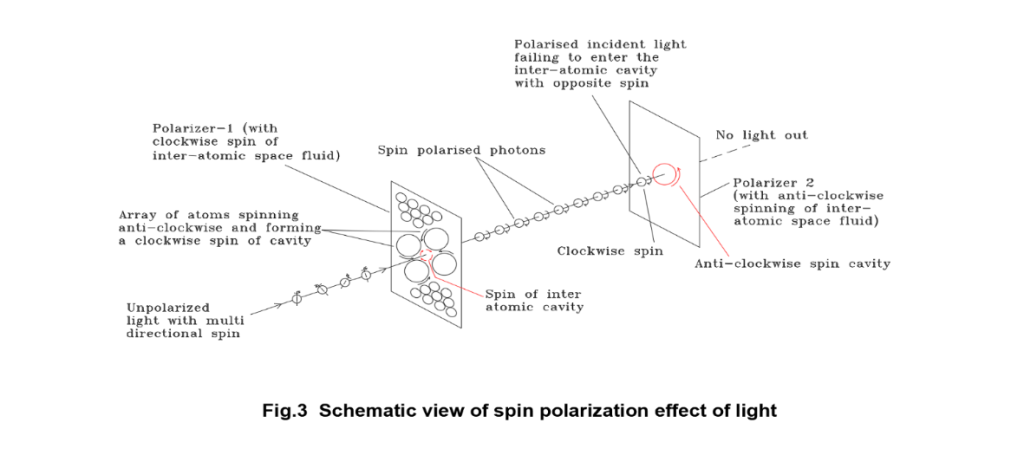
Light particles emerging out of the interface at different velocities attains the terminal velocity of the space medium [7]. Hence, light can be polarised in the process of reflection and transmission and the polarised light particles have different states of charge potential and spin potential. The polarised light emerging out of an interface fails to penetrate another interface structure for onward transmission where it exhibits polarisation effect. All transparent materials and their surfaces are not polarizers because the availability of free pholetrons in larger numbers is a criterion for polarisation of light, thus only some materials are polarizers. Hence, polarization of light is a structure dependent property of material and its interface.
Scattering of light
Light falling on an interface medium or transiting through a medium may get absorbed partly or fully in the medium where other characteristic charge particles of the medium are released to attain charge equilibrium. Thus, the characteristic property of scattered rays is different from the characteristic property of the incident ray. At present the characteristic property of light in the wave concept is given by frequency of wave which in the reality-based particle concept is expressed through the charge state property of the particle.
Conclusion
At present both the particle concept and the wave concept of light are absolutely required to understand different phenomena of light. Thus, duality of light is accepted as the inherent reality of nature. According to this author the wave concept of light without a tangible medium is not feasible therefore, all phenomena of light are required to be explained through the reality-based particle concept of light. The author has introduced the new structural concept of light particles with charge features and the fine structure of space mediums having field features. Using the new concepts of light particle and medium the author has successfully analysed and justified the constant velocity, rectilinear propagation, reflection, refraction, diffraction and interference phenomena of light. This paper explains polarisation and scattering phenomena of light from the same new concept of light particle and the medium. The revised particle concept of light is feasible, reality-based and capable of explaining all phenomena of light without duality.
Reference
- https://philosophyofnature.org.in/electric-and-non-electric-charges-and-their-inter-conversion.
- https://philosophyofnature.org.in/mass-space-structure-of-centrally-organized-systems.
- https://philosophyofnature.org.in/different-domains-of-nature.
- https://en.wikipedia.org/wiki/Ionosphere#:~:text=The%20ionosphere%20is%20a%20shell,referred%20to%20as%20the%20ionosphere.
- Interference and Diffraction of light, Article-2, Issue-2, Volume-4, Towards Unifications of Sciences.
- https://philosophyofnature.org.in/micro-micro-structure-of-interfaces-and-photonic-charge-field-a-reality-based-classical-explanation-of-reflection-and-refraction-of-light.
- https://philosophyofnature.org.in/a-new-vision-of-light-and-space-the-cause-behind-constant-velocity.
I am regular reader, how are you everybody? This article posted
at this web page is in fact nice.
Hey! This post couldn’t be written any better! Reading this post reminds me of my previous room mate!
He always kept talking about this. I will forward this article to
him. Pretty sure he will have a good read. Many thanks for sharing!