
INSTITUTE OF PHILOSOPHY OF NATURE
Author

Abstract
Synchrotron radiation exhibits well-established polarization characteristics, including linear, circular, and elliptical polarization. The present paper proposes a reality-based structural interpretation of these polarization features within the author’s previously developed mass–space framework. In this framework, an electron possesses an extra-nuclear space structure containing space-matter particles, and progressive reduction of this structure with increasing velocity provides the basis for the emission of radiation. The present study extends this structural concept to charge polarization and proposes that the spatially asymmetric distribution of charge and mass within the emitted structures may produce directional polarization. Quasi-neutral compound photon structures are hypothesized to acquire preferential longitudinal orientation, providing a possible interpretation of linear polarization. At the boundary of the radiation beam, interaction with the surrounding structured space medium is further proposed to produce rotational motion, giving rise to circular or elliptical polarization depending on the symmetry of the internal structure. The proposed interpretation is intended as a conceptual physical hypothesis and requires further mathematical development and experimental verification.
Keywords: Synchrotron radiation, Linear polarization, Circular polarization, Elliptical polarization, Mass-space framework, Extra-nuclear space structure.
Introduction
Synchrotron radiation emitted by relativistic charged particles is characterized by strong polarization in addition to its broad spectrum and pronounced forward directionality. Classical electrodynamics and special relativity provide successful mathematical descriptions of these observed properties. The present study explores an alternative causal interpretation based on the physical structure of the radiating electron and the state of the emitted radiation.
The present work forms the second part of the author’s previously developed reality-based interpretation of synchrotron radiation. In the earlier work, an electron was proposed to possess an extra-nuclear space structure whose effective dimension and interaction cross-section progressively decrease with increasing velocity [1] [2]. A mathematical treatment of this structural reduction and its relationship with the dynamics of high-speed particles have been developed in the author’s earlier studies. The same concept was subsequently applied to synchrotron radiation, where progressive reduction of the electron’s extra-nuclear structure was proposed to expose and release space-matter particles from successively deeper regions of the structure.
The present paper extends this previously developed structural model to the polarization of synchrotron radiation. It considers charge polarization as a consequence of an asymmetric mass–space distribution and proposes that the emitted radiation may form quasi-neutral compound structures possessing residual directional charge and mass–space characteristics. Their preferential orientation during propagation is proposed to provide a possible structural basis for linear polarization. Further interaction of radiation structures at the boundary of the beam with the surrounding structured space medium is hypothesized to produce rotational motion, providing a possible interpretation of circular and elliptical polarization.
Charge Potential in the Mass–Space Framework
The existence of electric charge as a property associated with matter, rather than as an independently existing physical entity, suggests that charge may be understood as a state property of matter within the mass–space integral system proposed in this framework. On this basis, a new concept of absolute charge potential is introduced in terms of the ratio of mass to the space holding by that mass:
Φc=m/s
where m represents mass and s represents the corresponding space holding of the mass. The quantity Φc is referred to here as the absolute charge potential of matter.
According to this framework, when matter within a given frame of reference maintains a uniform mass–space ratio, it is considered to be in mass–space equilibrium with respect to that frame. Since there is no spatial variation of the proposed charge potential, there is no potential difference to produce charge interaction within that local system. Matter therefore exhibits charge neutrality relative to its surrounding matter.
This concept also provides a basis for distinguishing between relative charge potential and absolute charge potential. Charge neutrality observed in one frame of reference need not imply that the absolute charge potential of the matter is zero. Rather, neutrality signifies that the matter and its surrounding environment are at the same charge-potential level within the considered frame.
For example, matter situated on the surface of the Earth may possess an absolute charge potential denoted by
ΦcE=(m/s)E
while matter situated on the surface of Jupiter may possess a different absolute charge potential,
ΦcJ=(m/s)J
Matter within each respective environment may remain charge-neutral because its charge potential is in equilibrium with the surrounding matter. However, if matter initially in the terrestrial environment is abruptly transferred to the Jovian environment, its original mass–space state may no longer correspond to the local equilibrium condition. The resulting difference between the charge potential of the transferred matter and that of its new surroundings can therefore produce charge activity until a new mass–space equilibrium is established.
For practical measurement, a relative charge-potential scale may be defined by assigning the equilibrium potential of a selected reference environment as zero. Thus, the Earth’s surface may be taken as the zero of a terrestrial relative charge-potential scale, while the surface of Jupiter may independently be taken as the zero of a Jovian relative scale. These two reference zeros do not necessarily represent the same absolute charge potential. In this sense, assigning zero charge potential to neutral matter is a consequence of the chosen relative scale rather than a statement that neutral matter possesses no absolute charge potential.
This distinction is analogous, within the present framework, to the distinction between an absolute state quantity and a reference-dependent potential difference. Charge neutrality is therefore interpreted as equality of charge potential between a system and its relevant surroundings, rather than as the absence of charge potential.
Electric Charge Potential
For a particle of mass m carrying electric charge q, the conventional specific electric charge is
σq=q/m.
For a specified value of specific charge, the conventional electric potential remains a separate physical quantity. In the present framework, however, the proposed charge potential is defined through the mass–space relation,
Φc=(m/s),
where s denotes the space holding of the mass. Equivalently, its reciprocal may be written as
s/m
representing the space holding per unit mass.
The proposed definition is intended to describe the state of matter through its mass–space organization, rather than to replace the conventional definition of electric potential used in electromagnetic theory. The quantity m/s is therefore introduced as a new theoretical measure of charge potential within the mass–space framework.
Thermal Charge Potential
The same mass–space concept is extended to the thermal domain. Temperature is conventionally used to characterize the thermal state of matter. In the present framework, temperature is interpreted as a manifestation of the charge-potential state associated with the mass–space organization of matter.
For a unit reference quantity, the thermal charge potential is represented by
Φt=t,
where t denotes temperature. Within the proposed framework,
t≡m/s,
so that temperature is interpreted as a measure of the mass–space state or thermal charge potential of the system.
Accordingly, the framework proposes that the same fundamental ratio,
Φc=m/s,
can be used as a generalized measure of state property across different domains of matter. At the microscopic scale, the manifestation of charge is identified primarily with electric phenomena, whereas at the finer micro-micro scale, including the domain associated with photons and other field-forming entities, the corresponding state is interpreted in terms of photonic or thermal charge potential.
Thus, the proposed framework seeks to establish a common mass–space basis for electric, photonic, thermal and celestial charge potentials. The intention is not to identify these phenomena as experimentally identical, but to propose that their respective state properties may be represented through a common underlying mass–space relation. The range of charge interactions may differ across domains because the lower limit of an interaction is constrained by the characteristic dimensions of the interacting structure, whereas the upper limit depends on the mass content of the nucleus. Consequently, the size of the extranuclear space structure is influenced by the range of mass–space interaction under the prevailing background conditions [3].
In microscopic particles, the nucleus contains a highly concentrated amount of mass within an extremely small region. Within the proposed mass–space framework, this high mass concentration defines the lower limit of the interaction range because the dimensions of the nucleus are many orders of magnitude smaller than those of macroscopic structures.
According to the proposed framework, the reduced dimensions of microscopic structures permit charge interactions over extremely short ranges that are not ordinarily observed in macroscopic bodies. Furthermore, if the strength of mass–space interaction follows an inverse-square dependence, the interaction strength may increase significantly as the characteristic dimensions of the interacting domain decrease. Each transition to a finer structural domain may therefore involve a corresponding change in both the range and the strength of the interaction.
This framework provides a possible explanation for why interactions associated with particles from different domains appear fundamentally different. However, within the present theory, these differences are interpreted as domain-dependent manifestations of a common mass–space interaction rather than as evidence that the interactions are already established to be identical in conventional physics. In the present framework, charge interaction is interpreted as a manifestation of mass–space interaction, with charge characterised in terms of the mass and space parameters associated with matter [4]. Thus, the proposed invariance of the underlying mass–space interaction provides a common basis for interpreting the range and strength of charge interactions across different domains.
Mass–Space Equilibrium and Charge Neutrality
Within this framework, matter at every scale and in any domain is regarded as a mass–space integral system [3]. In its natural state, a system tends toward mass–space equilibrium with its surrounding matter. Under equilibrium conditions, the charge potential of the system and its surroundings is equal within the relevant domain, and the system consequently exhibits charge neutrality [4].
A macroscopic body may contain structures belonging to several domains simultaneously. Each domain may establish its own mass–space equilibrium while remaining coupled to the other coexisting structures. Consequently, equilibrium at the macroscopic level does not necessarily imply the absence of internal differences in the state properties of the constituent domains.
Any displacement of matter from its equilibrium condition produces a change in its mass–space state relative to its surroundings. Within the proposed framework, this change is interpreted as a change in charge state. The subsequent tendency toward restoration of mass–space equilibrium constitutes the fundamental mechanism associated with the release or absorption of energy.
Charge neutralization involves recombination or interaction with particles having opposite charge characteristics. When the opposing charges are equal in magnitude, complete charge neutralization can occur by their union at the corresponding domain level. When they are not equal, complete restoration of the neutral state may require participation from structures belonging to a finer domain.
In the mass–space interpretation, mass-rich structures are associated with positive charge characteristics, whereas space-rich structures are associated with negative charge characteristics [5]. Complete restoration of mass–space equilibrium therefore requires compensation between mass-rich and space-rich components across the relevant domains.
An important consequence of this interpretation is that macroscopic charge neutrality does not necessarily imply the complete absence of an underlying charge signature. A particle may appear electrically neutral at one observational scale while retaining internal mass–space asymmetries that are compensated through finer-domain structures. Thus, within the proposed framework, a neutral microscopic particle may still carry an underlying signature of its constituent charge states, even though its net observable charge is zero.
Similarity between charge activity and thermal activity
There is a useful analogy between electrical charge activity and thermal activity; however, at this stage, it may not be appropriate to state that they originate from the same physical phenomenon. In established physics, they are treated as distinct physical phenomena, although both can be described in terms of gradients, potentials, transport, and equilibrium.
Existing similarity between charge activity and thermal activity
| Electrical activity | Thermal activity | Common feature |
| Electric potential difference ΔV | Temperature difference ΔT | Driving potential difference |
| Electric field E=-∇V | Temperature gradient ∇T | Spatial gradient |
| Electric current I | Heat flow Q̇ | Transport process |
| Electrical resistance R | Thermal resistance Rth | Opposition to transport |
| Charge equilibrium | Thermal equilibrium | No net macroscopic flow |
| Conductivity σ | Thermal conductivity k | Material-dependent transport property |
The observed structural similarity between charge activity and thermal activity suggests the possibility of investigating whether a more fundamental physical state variable can provide a common basis for understanding both types of activity. Within the present framework, the proposed description of mass in terms of a photonic mass unit, charge in terms of a photonic charge unit [6], and matter as a mass–space structure containing a nucleus and an associated extra-nuclear space structure provides a possible basis for developing a unified description of the micro and micro–micro domains [7].
Furthermore, the proposed atomic structure, including its extra-nuclear space structure, space-matter particles, and orbital particles or bodies, is considered to exhibit structural features that may be comparable, at a conceptual level, with those observed in larger gravitational systems such as the Solar System. If such structural correspondence can be established quantitatively, it may provide a basis for examining possible connections between the macro, micro and micro–micro domains.
From this perspective, the domain-specific laws currently used in physics may be regarded as descriptions developed for particular scales and classes of observable phenomena. The present framework proposes that these apparent domain distinctions may arise from differences in scale, structure, and interaction conditions rather than necessarily representing fundamentally unrelated physical principles. The underlying uniformity of structure and interaction, when supported by theoretical derivation and experimental evidence, could therefore provide a deeper basis for connecting phenomena across different domains of nature.
The structural mechanism proposed in the present paper is an extension of the author’s previously developed mass–space model of particle dynamics. In earlier work, the author proposed that an accelerated charged particle possesses an extra-nuclear space structure whose effective dimension and interaction cross-section progressively decrease with increasing velocity as a consequence of interaction with the structured space medium. A mathematical formulation of this velocity-dependent structural reduction was developed and shown to lead to a corresponding reduction in the effective interaction cross-section. The same structural concept was subsequently applied to synchrotron radiation, where progressive reduction of the electron’s extra-nuclear structure was proposed to expose successively deeper regions containing space-matter particles and thereby influence the energy and directional characteristics of the emitted radiation. The present paper extends this previously developed framework to examine the charge-polarization state of the remaining structure and its possible relationship with the polarization characteristics of synchrotron radiation.
Cause of Charge Polarization in a Charged Particle
Electric charge is a recognized phenomenon associated with microscopic particles. However, the present author has attempted to identify a possible replica of charge activity in other domains of nature by exploring the possibility of a common basic cause underlying charge in matter. If the fundamental cause remains the same, charge-related interactions in different domains may appear different in their range and strength because of differences in the geometrical mass-space configuration characteristic of each domain and scale. Such domain-specific differences may have led to the recognition of alternative explanations for non-electric charge-related phenomena in nature, thereby obscuring the possibility of a common underlying physical basis. The present approach therefore explores whether such apparently different phenomena can be interpreted within a more unified framework.
According to the proposed model, an electron accelerated to progressively higher velocities successively lose a portion of its extra-nuclear space structure. As the velocity approaches the velocity of light, only a small fraction of the original extra-nuclear space structure is considered to remain associated with the nucleus. The space structure closer to the nucleus is proposed to possess photonic charge-polarized shell features, analogous in a conceptual sense to the polarized atmospheric structure of the Earth (Fig.1), in which charged layers of the ionosphere occur in an organized spatial configuration.
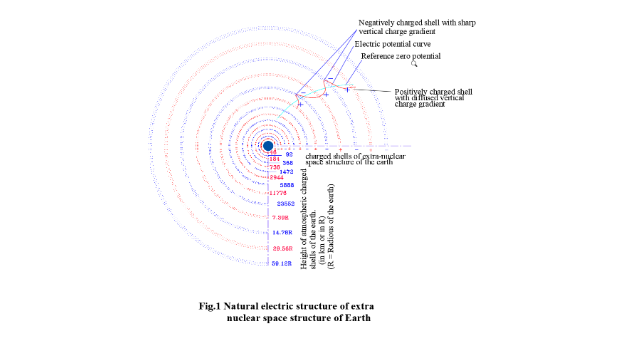
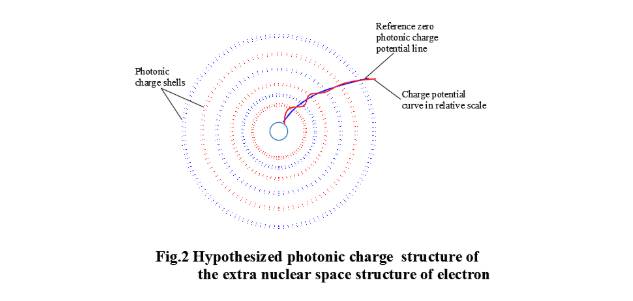
A similar photonic charge polarization within the extra nuclear space structure of electron has been hypothesized (Fig.2). At very high velocities, the erosion of the extra-nuclear space structure is proposed to be associated with the release of photons from the outer portions of the polarized shell. This release disturbs the equilibrium of the polarized structure of the electron in its dynamic state. According to the proposed mechanism, restoration of this equilibrium involves the release of photons from the inner charge-polarized shells as well. Consequently, the photons released from different regions of the extra-nuclear space structure of the electron during relativistic motion are hypothesized to contain different charge characteristics, including positive and negative photonic charge characteristics. These emitted photons subsequently constitute the synchrotron radiation beam.
Within the proposed framework, charge interaction among the emitted photons in the beam may lead to the formation of quasi-neutral composite or compound photon structures having residual directional charge properties. Because of their directional mass-space structure, these compound photons are proposed to respond differently to the surrounding space medium during propagation. Their longer structural dimension is hypothesized to orient preferentially along the longitudinal axis of the beam, corresponding to the direction of propagation and the condition of minimum resistance from the surrounding space medium. This proposed preferential orientation provides a physical basis for the observed linear polarization of the synchrotron radiation.
An unsymmetrical distribution of mass or charge within the internal structure of a particle or body can result in directional variations of its constituent mass-space structure. In the present framework, such directional variation is described in terms of charge polarization or field polarization. When a negatively charged particle combines with a positively charged particle, the resulting combined structure may have an approximately zero net charge while retaining an internal polarized charge distribution because of the asymmetrical spatial distribution of the constituent charges. Thus, in the proposed model, net charge neutrality does not necessarily imply the complete disappearance of charge polarization.
In reality, complete charge neutralization is proposed not to take place because of the non-availability of the corresponding antiparticle within the relevant Debye length. Consequently, a non-uniformity of charge at the fractional level may persist within the combined photon structure. This residual non-uniformity is considered responsible for charge polarization within the compound photon. The resulting compound photon therefore possesses an asymmetric mass-space structure with a preferred geometrical direction.
During propagation, the proposed compound photons tend to orient their longer structural axis parallel to the axis of the synchrotron radiation beam while simultaneously tending toward the direction of minimum resistance from the surrounding space medium (Fig.3). This conceptual mechanism is therefore hypothesized to provide a structural explanation for the predominantly linear polarization of synchrotron radiation.
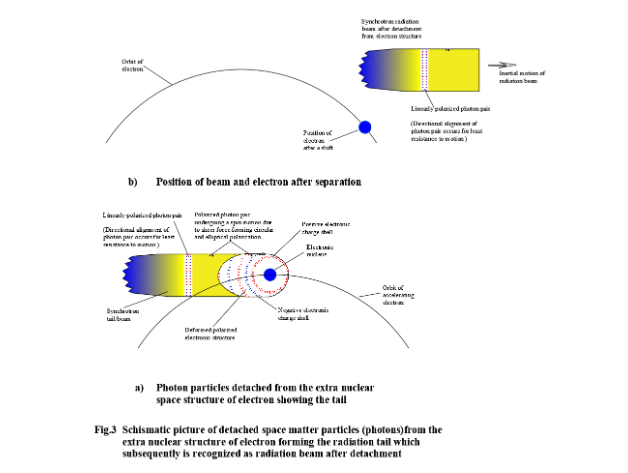
The linearly polarized compound photons located near the boundary of the radiation beam are further proposed to experience a shear force at the interface between the radiation beam and the surrounding space medium through which the light beam propagates. This shear interaction may impart an additional rotational motion to the compound photons in the boundary region. For a compound photon having a symmetrical mass-space structure, the additional rotational motion is proposed to develop into a circular motion, corresponding to circular polarization. For a compound photon having an unsymmetrical mass-space structure, the rotational motion may instead become elliptical, corresponding to elliptical polarization (Fig.3).
Accordingly, the present framework proposes that the different polarization characteristics observed in synchrotron radiation like linear, circular and elliptical may be associated with different geometrical and dynamical configurations of the charge-polarized compound photon structures. The proposed mechanism thus attempts to provide a common structural interpretation connecting charge distribution, charge polarization, mass-space asymmetry, directional orientation and the observed polarization characteristics of synchrotron radiation. This interpretation is proposed as a conceptual physical hypothesis and requires further theoretical formulation and experimental verification.
Conclusion
The present paper proposes a structural, reality-based interpretation of the polarization characteristics of synchrotron radiation within the mass–space framework developed by the author. The proposed mechanism relates the progressive reduction of the electron’s extra-nuclear space structure to the release of charge-polarized radiation, formation of quasi-neutral compound photon structures, their preferential longitudinal orientation, and subsequent rotational effects at the beam boundary. These structural and dynamical configurations are proposed to provide a common physical interpretation of linear, circular, and elliptical polarization. The work is intended as a conceptual physical hypothesis extending the author’s earlier quantitative structural model; its polarization-specific mechanism requires further mathematical formulation and experimental verification.
Reference
- https://philosophyofnature.org.in/a-new-vision-of-light-and-space-the-cause-behind-constant-velocity.
- https://philosophyofnature.org.in/understanding-the-structure-and-dynamics-of-galaxy-and-the-reality-behind-the-concepts-of-black-hole-dark-matter-and-random-motion-of-molecules-in-gas/?utm_source=chatgpt.com.
- https://philosophyofnature.org.in/mass-space-structure-of-centrally-organized-systems.
- https://philosophyofnature.org.in/new-concept-of-electric-charge-in-matter.
- https://philosophyofnature.org.in/electric-and-non-electric-charges-and-their-inter-conversion.
- https://philosophyofnature.org.in/towards-a-new-comprehensive-universal-science.
- https://philosophyofnature.org.in/different-domains-of-nature.