Reality-Based Causal Interpretation of Synchrotron Radiation- Part I: Structural Dynamics, Energy and Beam Collimation

Author

Abstract

Synchrotron radiation is characterized by high brightness, a broad continuous spectrum, strong polarization, and pronounced forward collimation at high electron velocities. The present paper proposes a reality-based conceptual interpretation of these characteristics based on a structured mass–space structural model of the electron except the polarization phenomena which is dealt in part- II of this paper. In this framework, the electron possesses an extra-nuclear space structure containing space-matter particles identified as photons. As the electron is increasingly accelerated, its extra-nuclear structure is proposed to undergo progressive deformation and size reduction, releasing particles from successively deeper regions. The changing spatial state of the released particles is proposed to account for the increase in photon energy and the observed changes in the radiation spectrum. The reduction in the emission region, together with increasing longitudinal dominance over transverse dispersion and the proposed increase in particle momentum, provides a physical interpretation of the progressive narrowing of the synchrotron radiation beam. A mathematical analysis of the reduction in the extra-nuclear structure is presented, yielding a velocity-dependent expression consistent with the corresponding relativistic expression while arising from a different physical interpretation. The proposed framework therefore provides an alternative conceptual basis for relating electron velocity, structural reduction, photon energy, radiation intensity and beam collimation.

Keywords: Synchrotron radiation, Extra-nuclear space structure, Space-matter particles, Beam collimation, Photon energy, Structural dynamics. 

Introduction

Synchrotron radiation is electromagnetic radiation emitted by relativistic charged particles, particularly electrons, when their trajectories are curved by an external magnetic field. The continuous change in the direction of velocity produces centripetal acceleration, causing the electrons to lose energy through electromagnetic radiation.

At low velocities, radiation is emitted over a relatively broad range of directions. As the electron velocity approaches the speed of light, however, the radiation becomes concentrated around the instantaneous direction of motion within a narrow forward cone whose characteristic angular width is approximately (1), where () is the Lorentz factor. This relativistic beaming is a well-established experimental feature of synchrotron radiation. 

Classical electrodynamics combined with special relativity successfully predicts the angular distribution, spectrum and intensity of synchrotron radiation. Nevertheless, the mathematical formulation does not identify a distinct microscopic physical process that can be conceptually visualized as the origin of the progressive concentration of radiation into the forward cone. The physical interpretation of this relativistic beaming therefore remains open to alternative conceptual approaches.

Synchrotron radiation also possesses a broad continuous spectrum extending from infrared and visible wavelengths to ultraviolet and X-rays. Its high brightness, strong collimation, polarization and broad spectral range make it an important tool in crystallography, spectroscopy, materials science, biology, medicine, nanotechnology, semiconductor research and astrophysics.

The present study explores a reality-based conceptual interpretation of synchrotron radiation. The approach is motivated by the premise that the fundamental principles governing nature operate consistently across different physical domains. Consequently, observable macroscopic phenomena may provide useful conceptual analogies for interpreting processes occurring in microscopic or otherwise inaccessible domains, provided that the analogy is treated as a conceptual guide rather than as a direct equivalence of physical mechanisms. 

Conceptual Basis of the Present Study

A mathematical description can accurately establish relationships among observable quantities without necessarily providing an intuitive physical picture of the underlying process. The present work therefore seeks an observable natural phenomenon in which increasing dynamical activity is accompanied by the release of energy or matter from a moving system. Such an analogy may help formulate a physically transparent interpretation of synchrotron radiation.

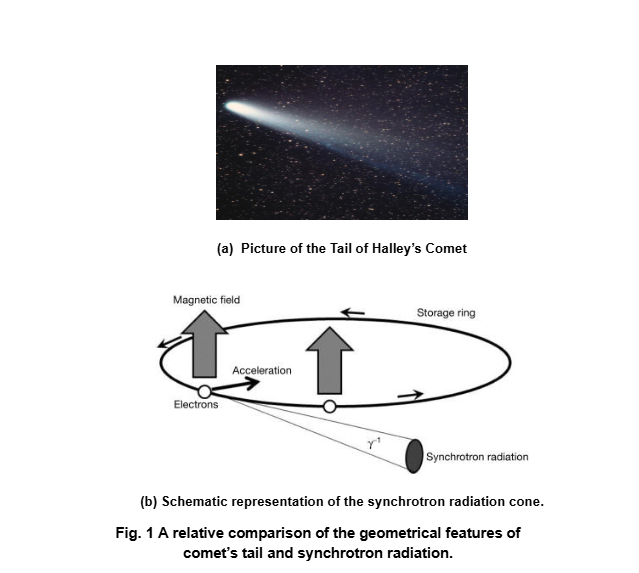
In this context, the activity of Halley’s Comet during its approach to the Sun provides an interesting macro-domain analogy. As the comet approaches the Sun, its orbital velocity and dynamical activity increase. Solar heating and the changing dynamical conditions cause volatile materials to escape from the cometary nucleus, producing a bright coma and an extended tail containing gas, ions, electrons, and dust particles.

The comet and a relativistic electron in a synchrotron are, of course, fundamentally different physical systems. The proposed analogy is therefore not intended to imply that the mechanisms of cometary activity and synchrotron radiation are identical. Rather, both systems illustrate a broader conceptual pattern in which increased dynamical activity is associated with the release of energy or material from the moving system.

This analogy provides a starting point for examining whether the observed increase in directional concentration of synchrotron radiation with increasing electron velocity can be interpreted in terms of an underlying physical emission mechanism rather than solely through relativistic field transformation. The subsequent analysis develops this possibility while retaining the experimentally established characteristics of synchrotron radiation.

The Role of the Proposed Extra-Nuclear Space Structure in Synchrotron Radiation

According to the proposed concept of the physical universe, mass and space are the only two basic constituents of nature [1]. Every material entity, irrespective of its domain, is regarded as an integrated mass–space system [2]. In mass-space equilibrium, such a system remains charge neutral, whereas departure from equilibrium produces charge manifestation [3]. Matter is considered to exist across hierarchical domains—the macro, micro, micro-micro and macro-macro domains without excluding the possibility of still finer or larger domains [4].

The perception of structure is dependent on the observational scale. Just as atomic mass and structure become insignificant when viewed at the scale of celestial bodies, the mass and structural dimensions of micro-micro domain particles (photons) may become insignificant at the atomic scale. This may explain why photons are conventionally treated as massless and structureless. In the present framework, however, the very possession of energy in photon is taken to imply a finite mass as the carrier of the energy. The mass of electron and photon develops a mass-space structure having nucleus and extra nuclear space structure [5].

The proposed structural continuity of nature assumes that every material entity possesses a nucleus and an associated extra-nuclear space structure [2]. This concept is evident at the macroscopic level in planetary and stellar systems and is extended here to atomic and subatomic domains. In an atom, the conventional model describes electrons occupying the extra-nuclear region but does not explicitly consider the physical structure of the intervening space medium [6]. The planetary atomic model unknowingly ignored the structural aspect of intervening medium, thereby it deviated away from reality and could not explain the spectra. Therefore, one should be careful in incorporating all features of reality observed in macro domain while modelling a system in unseen finer domain for understanding the structural and functional reality in finer domain. A reality-based model developed by following the consistency and uniformity of nature across domains, may not require any domain specific abstract concept to understand different phenomena. In the present framework, the extra nuclear space structure of atom contains space-matter particles of micro-micro domain (photons) and forms an integral part of the atomic structure [2] [6].

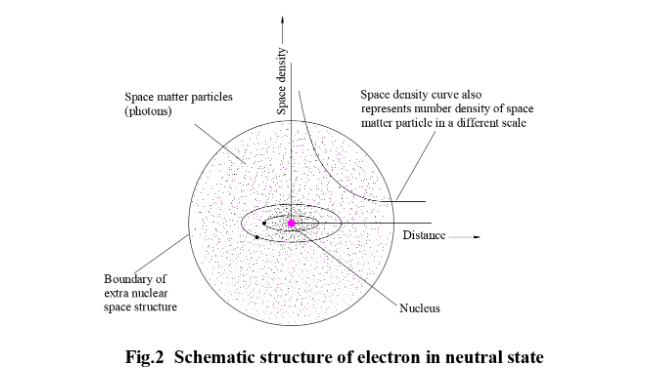
The structural similarity is extended to the electron and photon. An electron is considered a hierarchical mass–space system consisting of a central nucleus and an extra-nuclear space structure containing space matter particles of micro-micro domain (photons) (Fig.2). Likewise, photon is proposed to possess an internal mass–space structure with nucleus and extra nuclear space structure rather than being a completely massless and structureless point entity [4]. Thus, the extra-nuclear space structure is regarded as an essential component of matter in different hierarchical levels. An accelerated electron in the synchrotron goes on increasing its tangential velocity approaching the speed of light where portions of the extra nuclear space structure of the electron gets continuously swept away from the outer part of the structure, thereby reducing the dimension of extra nuclear space structure more and more at higher and higher velocity of the electron. The detached space structure inherits the instantaneous tangential velocity of electron and continues to move in a straight line due to inertia of motion. In the present framework, the space matter particles released from the outer boundary of the structure of electron go to form the synchrotron radiation beam. The state property of space matter particles released from boundary changes with the change in boundary condition in dynamic state. With continuous increase of tangential velocity of electron in the synchrotron, continuous erosion of the space structure occurs due to sweeping action at boundary that results continuous decrease of the size of extra nuclear space structure of the electron. The reduction of size of space structure by erosion from boundary at high speed exposes the inner space matter particles that changes the boundary condition which in turn reflect upon the quality of synchrotron radiation. At very high velocity, close to c, the space matter particles are released from the proximity of nucleus of electron. Thus, the quality of synchrotron radiation changes with the change of state property of space matter particles those go to form the beam.

A deeper understanding of the extra-nuclear structure of electron and the spatial variations of properties of space matter particles is absolutely necessary to understand the features of synchrotron radiation. These are discussed below.

  1. Space density structure: Due to basic mass-space attraction and space-space repulsion there exists a space density graded structure surrounding the nucleus where the nucleus and the extra nuclear density graded physical space associated to the nucleus form one integral system (Fig.2). The nucleus carries the extra nuclear space structure in its translation and rotation [2]. 
  2. Number density structure of space matter particles: The space structure contains space matter particles due to space-mass attraction [1]. The number density of space matter particles is directly proportional to space density (space content per unit volume). Thus, the number density of space matter particles goes on increasing rapidly towards the surface of the nucleus. One can visualize the increase of density of space matter particles from the study of the atmosphere of the earth. 
  3. Mass variation of space matter particles: An examination to the atmosphere of earth reveals that heavier atoms and molecules are stratified at lower altitude and lighter atoms such as hydrogen are stratified at higher altitude. One may hypothesize that the mass of space matter particles is high near the surface of the nucleus and goes on decreasing outwardly within the extra nuclear space structure and the phenomena holds good for the extra nuclear space structure of electron (Fig.2).
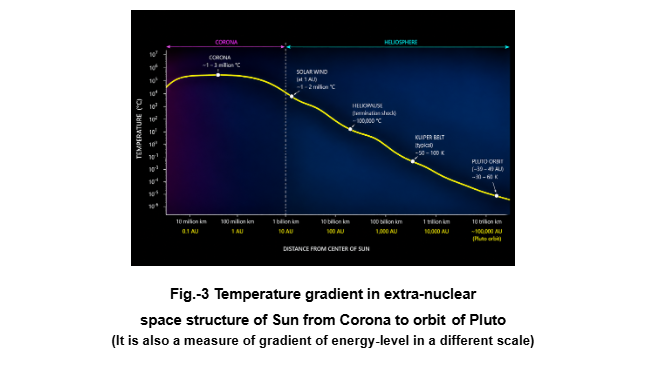
  4. Energy gradient: An examination to the extra nuclear space structure (atmosphere) of the sun reveals that there exists a temperature gradient from one million kelvin in solar corona to near zero kelvin at the boundary of solar system which imply the energy level of space matter particle goes on decreasing from proximity of nucleus to the boundary. One may get a feel of this phenomenon from the prevailing temperature of different planets in relation to their distance (Fig.3). The phenomenon is hypothesized to hold good for the extra-nuclear structure of electron. 

Similarities Between Cometary and Synchrotron Radiation

The activity of a comet provides a useful macroscopic analogy for the proposed mechanism. As a comet approaches the Sun, increasing solar heating, radiation pressure, and interaction with the solar wind disturb its outer structure. Volatile material is released and carried away as gas, ions, electrons, and dust, producing the coma and tail. Thus, increased dynamical excitation is accompanied by progressive release of matter from the cometary structure.

In the proposed synchrotron model, an analogous process occurs at a much smaller scale: acceleration of the electron disturbs its extra-nuclear space structure that results in the release of photons. The cometary tail and synchrotron radiation beam are therefore regarded as qualitatively analogous manifestations of dynamically activated structures, although their actual physical environments are different.

Table 1. Conceptual correspondence between cometary activity and synchrotron radiation

Comet tail Synchrotron radiation beam
Accelerated motion of comet in the Sun’s gravitational field Accelerated motion of electron in a magnetic field
Activity increases with increasing dynamical conditions near perihelion Radiation increases with increasing particle energy and acceleration
Continuous release of atomic and subatomic particles from the accelerated comet Continuous emission of photons by the accelerated electron
Highly directional tail Highly directional radiation cone
Emission intensity varies with dynamical state and gravity field Radiation intensity varies with particle energy state and magnetic field
Internal activation produces observable emission from extranuclear structure Proposed disturbance of the electron’s extra-nuclear structure produces photon emission

The analogy is therefore intended to establish a conceptual continuity between dynamical excitation, structural disturbance, and particle release across different physical domains. It does not imply that cometary emission and synchrotron radiation are exactly identical phenomena.

Reality-Based Mechanism of Decrease in Spreading Angle of Synchrotron Beam- with Increasing Particle Velocity

The physical mechanism responsible for the decrease in the spreading angle of synchrotron radiation with increasing electron velocity may be qualitatively understood by comparison with the behavior of high-velocity plasma jets or high velocity oxy-fuel (HVOF) spray particle plumes. In such jets, the spreading of the plume is governed by the competition between the dominant forward momentum of the jet and the forces or disturbances that produce transverse dispersion following aerodynamics. As the forward velocity increases, the axial momentum becomes increasingly dominant, while the relative effect of transverse disturbances becomes proportionately smaller. This gives an apparent decrease of transverse velocity due to dispersion. Consequently, the spreading angle of jet or particle plume decreases thereby, the beam becomes more concentrated along its principal direction of motion [7].

A similar physical mechanism may be applied to synchrotron radiation, within the proposed stream of space matter particles (photons) through vacuum medium. In the proposed framework, the radiation is considered to originate from the dynamically excited extra-nuclear space structure of the electron. When the electron moves with increasing velocity in the magnetic field, its dynamical excitation increases and the outer portion of its extra-nuclear space structure becomes progressively more susceptible to separation from the electron. The progressive release of space matter particles from boundary decreases the size of the extra nuclear space structure thereby, the emitted radiation beam is formed by the inner space matter particles of the electron structure at increased velocity. Thus, the quality of synchrotron radiation is governed by the spatial properties of space matter particles within the electron structure hance it is a function of velocity. The dynamical state of the electron changes with velocity, and this change can modify both the directionality and the other observed properties of the radiation. The velocity of space matter particles after detachment from electron structure inherits the instantaneous tangential velocity of electron. Thus, higher is the tangential velocity of electron, higher is the axial velocity of synchrotron beam.

In atmospheric plasma jet, the stream of plasma particles interacts with surrounding medium (the gas composed of atomic and molecular particles) the gross effect of which is accounted by the aerodynamics drag whereas in synchrotron radiation beam, the stream of photons interacts with the surrounding vacuum-medium (the gas composed of neutral photons). The above comparison is hypothesized in the present framework. In a plasma jet, the narrowing of the plume is produced by fluid-dynamical interactions between the jet and the atomic/molecular gas medium whereas in the synchrotron radiation propagating through photonic gas medium (structured space medium) is guided by the fluid-dynamics of photon gas. The relevant common principle is instead the relationship between dominant forward propagation and transverse dispersion.

Thus, the proposed synchrotron mechanism can be stated more generally as follows:

When the longitudinal dynamical component of the emitted plasma jet increases more rapidly than its transverse dispersion, the angular distribution of the emitted jet becomes progressively narrower.

This principle is very much applicable to the proposed space-matter-particle (photon) forming the synchrotron radiation beam where the conventional aerodynamics drag force of atomic gas is replaced by the proposed fluid dynamics drag of photonic gas medium.

Spreading angle

The essential feature of the proposed mechanism of spreading angle is the distinction between the longitudinal component and transverse component of the emitted particle.

The longitudinal component is associated with the instantaneous tangential velocity of the excited electron, whereas transverse velocity is derived from fluid dynamics interaction. The transverse velocity is the cause of spreading of the beam. The half spreading angle θ may therefore be represented as

where (v∥) is the longitudinal propagation velocity and (v⊥) represents the transverse velocity or dispersion of the emitted space-matter particles.

When the electron velocity increases, the longitudinally directed velocity of photons in the synchrotron radiation becomes increasingly dominant. The transverse dispersion, however, does not increase proportionally, thus, the ratio v⊥/v∥ decreases, consequently the radiation is confined to a smaller angular region.  Accordingly, the observed decrease of the spreading angle of synchrotron radiation with increasing electron velocity may be interpreted in the proposed framework as a consequence of increasing directional dominance of the dynamically released space-matter particles.

At relatively low electron velocity, the emitted particles possess a comparatively broad angular distribution. Thus,

v⊥/v∥ is relatively large, hence θ is relatively large.

At progressively higher velocity, the longitudinal component becomes dominant, thus making

v⊥ >> v∥

θ≃ v⊥/v∥ becomes small

The radiation consequently becomes increasingly concentrated around the instantaneous direction of the electron motion.

In this interpretation, the synchrotron beam becomes narrow not because the emitted particles are necessarily subjected to an external collimating force, but because the relative magnitude of transverse dispersion decreases compared to the dominant longitudinal propagation. Again, the momentum of photons in synchrotron radiation increases due to the release of higher-mass photons at velocity close to c which reduces transverse dispersion. In this reality based frame work it is further hypothesized that heavier space matter particles (photons) remain closer to the electronic nucleus on the basis of observation of the earth’s atmosphere. An examination to the features of space matter particles in the extra nuclear space structure (atmosphere) of the earth, it is noticed that heavier space matter particles are located in the proximity of the surface of the earth and lighter and lighter particles are seen in the upper atmosphere. Presumably this structural feature also exists in the extra nuclear space structure of electron. When the velocity of accelerated electron increases continuously approaching the velocity of light, the physical dimension of the extra nuclear structure of electron becomes very small, thereby, the diameter of the beam at the instant of its release from electron is very small. Thus, at very high velocity, heavier photons with high energy potential are released from inner part of the structure.  Within the proposed space-matter-particle framework, the term ‘heavier photon’ refers to a space-matter particle possessing greater momentum due to increased mass. With this consideration, the spreading angle decreases further due to higher momentum of the heavier photon at increased speed. The proposed physical picture is also qualitatively consistent with the well-established observation that highly relativistic synchrotron radiation is strongly concentrated in the forward direction. In conventional electrodynamics this behavior is described by relativistic beaming, with a characteristic angular scale of the order

θ∼1/γ

The present model seeks to provide a different causal interpretation of the same geometrical behavior where the narrowing is attributed to the increasing directional dominance of the dynamically excited space matter particles released from the structure of the electron. In brief: Increasing forward dominance relative to transverse dispersion ⇒ Decreasing spreading angle. 

The fundamental mechanism of synchrotron radiation is considered to remain the same at all electron velocities, while its observed characteristics change significantly as the electron approaches relativistic velocities. In the present framework, these changes are attributed to progressive dynamical modification of the electron’s extra-nuclear space structure. The proposed interpretation therefore considers the structural state of the electron as the primary factor governing the direction, intensity, energy distribution and narrowing the angular spread of the emitted radiation.

The electron is considered a hierarchical mass–space system consisting of a nucleus surrounded by an extra-nuclear space structure containing bound space-matter particles identified here as photons [2]. Accordingly, radiation from an accelerated electron is interpreted not as creation of photons, but as the release of energetic photons already present in bound states within its extra-nuclear structure. The emitted photons therefore originate from the extra-nuclear region rather than directly from the electron’s nucleus.

Mathematical analysis of decrease of beam angle 

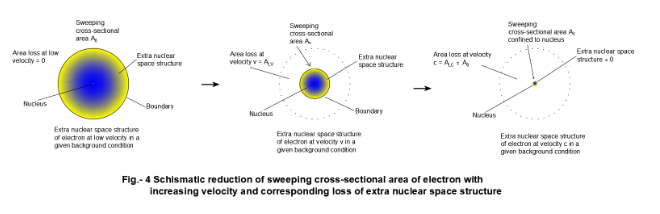
It is seen that the radius of extra nuclear space structure of electron decreases with the increase of velocity. The decrease of radius of electron structure is associated with the release of photons of higher mass at higher energy level, hence higher momentum. When the initial sweeping area Ao of electron at low velocity reduces to Av at velocity v then the area reduction factor Av/ A0 becomes a measure of the change in the quality of synchrotron radiation. The ratio Av/ A0 can be expressed in terms of velocity due to their dynamical relationship [8].

The electron loses a part of its extra nuclear space structure (ALv) at high velocity v (Fig.4). Thus, the instantaneous cross-section Av of the extra nuclear space structure of the electron in the dynamic state, (at velocity v), becomes equal to A0 – ALv. Hence, the area reduction factor at velocity v = Av/ A0 =(A0 – ALv)/A0 — eqn-1

The ratio (A0 – ALv)/A0 can be expressed in terms of velocity
ALv∝ v2

or ALv=kv2 where k is proportionality constant

Again, at velocity c, the area lost   ALc=kc2

At velocity c the area lost (ALc) = A0. (since at velocity c the electron loses its entire extra nuclear space structure).

Hence, the area reduction factor

Av/ A0=(A0 – ALv)/A0=(ALc-ALv)/ALc=(kc2-kv2)/kc2=(c2-v2)/c2 —  eqn-2

Area reduction factor = Av/ A0= πrv2/πr02= (rv/r0)2 —   eqn-3

Hence (rv/r0)2=c2-(c2-v2)/c2

Radius reduction factor rv/r0 =√((c2-v2)/c2))= 1/γ —    eqn-4

The value of γ as worked out here corresponds to a realistic dynamic whereas the value of γ in abstract relativistic dynamics make use of Lorentz factor.

Increasing Internal Energy-State of Photons in Synchrotron Radiation with Increasing Electron Velocity

In the proposed new concept, synchrotron radiation is understood as a stream of space-matter particles (photons) released from the extra-nuclear space structure of an electron. These photons are presumed to retain the spatial-state properties corresponding to their original locations within the electron and thereby transfer these properties to the emitted radiation beam.

As the velocity of the electron increases, progressively greater fractions of its extra-nuclear space structure are presumed to be stripped away from its outer boundary. Consequently, space-matter particles located at progressively smaller radial distances from the nucleus become exposed and available for release. Thus, radiation emitted at higher electron velocities is proposed to originate from increasingly deeper regions of the electron’s extra-nuclear structure. The changing characteristics of synchrotron radiation can therefore be interpreted, within this framework, as reflecting the different spatial-state properties of photons associated with different radial positions.

The proposed radial variation in photon properties is illustrated qualitatively by natural analogies. In the solar atmosphere, energy conditions generally increase toward the central region, while in the Earth’s atmosphere, heavier constituents are predominantly concentrated closer to the surface and lighter constituents occur at greater altitudes. By analogy, the present framework proposes that the internal energy state and mass of space-matter particles increase with decreasing radial distance from the electron nucleus.

Accordingly, photons originating from progressively deeper regions of the electron are proposed to possess higher internal energy states and greater mass. Their release at increasing electron velocities would therefore result in an increase in the energy content and momentum of the emitted radiation. This provides, within the proposed model, a qualitative explanation for the observed extension of synchrotron spectra toward higher photon energies and the substantial increase in radiation brightness as the electron velocity approaches the velocity of light.

The greater mass of the emitted space-matter particles is further proposed to produce greater momentum and kinetic energy. Particles possessing greater momentum would, within this framework, be less susceptible to transverse deflection caused by interactions with field particles. Consequently, the transverse deviation and spreading of the radiation would decrease, producing a progressively narrower and more strongly collimated synchrotron beam.

Thus, the principal velocity-dependent characteristics of synchrotron radiation—increasing brightness, extension toward higher photon energies, greater photon momentum, reduced beam spreading, and enhanced collimation—are interpreted as consequences of the progressive reduction in the radius of the electron’s extra-nuclear space structure. The radius reduction factor, represented by (1/γ ), therefore provides a conceptual link between the dynamical state of the electron and the changing properties of the emitted radiation. As the electron velocity approaches (c), the proposed model assumes that the radius of the extra-nuclear space structure tends toward zero.

Within this interpretation, the photons initially inherit the velocity associated with the electron’s dynamical state but subsequently accelerate through the surrounding vacuum medium until reaching the terminal velocity (c) [9]. The polarization characteristics linear, circular and elliptical are considered separately in Part II in relation to the geometry and structural properties of the electron.

Conclusion

The present study proposes a reality-based conceptual interpretation of synchrotron radiation in which the electron is regarded as a structured mass–space system possessing an extra-nuclear space structure containing space-matter particles identified as photons. With increasing electron velocity, this structure is proposed to undergo progressive reduction and release particles from successively deeper regions, thereby changing the energy-state properties of the emitted radiation. The mathematical analysis of structural reduction provides a velocity-dependent relationship consistent with the corresponding relativistic expression, while offering a different physical interpretation. Within the proposed framework, the increasing energy state and mass of released particles, together with increasing longitudinal dominance and reduced transverse dispersion, provide justification for the increasing brightness, higher-energy spectral extension and enhanced collimation of synchrotron radiation as the electron velocity approaches the velocity of light. The framework therefore offers an alternative conceptual basis for relating the structural dynamics of the electron to the principal observed characteristics of synchrotron radiation. The proposed reality-based approach may have broader significance for the comprehensive understanding of nature.

Reference

  1. https://philosophyofnature.org.in/basic-constituents-of-universe-and-their-interactions.
  2. https://philosophyofnature.org.in/mass-space-structure-of-centrally-organized-systems.
  3. https://philosophyofnature.org.in/new-concept-of-electric-charge-in-matter.
  4. https://philosophyofnature.org.in/different-domains-of-nature.
  5. https://philosophyofnature.org.in/towards-a-new-comprehensive-universal-science.
  6. https://philosophyofnature.org.in/modelling-atomic-system.
  7. https://www.sciencedirect.com/science/article/abs/pii/S1290072900011959?utm_source=chatgpt.com.
  8. https://philosophyofnature.org.in/reality-based-analysis-of-relativistic-dynamics.
  9. https://philosophyofnature.org.in/a-new-vision-of-light-and-space-the-cause-behind-constant-velocity.

Author

Share this article

Leave a Reply

Your email address will not be published. Required fields are marked *