
INSTITUTE OF PHILOSOPHY OF NATURE
Author

Abstract
Electricity, we use today, was invented in the eighteenth century. But there is evidence of electric battery in the treatise Agastya Samhita written about 3000 years back by the Vedic seer Maharishi Agastya. Description of production of electricity and its uses are found in this treatise. Based on the equipment and procedure explained in the book a battery was constructed which worked and produced electricity.
Keywords: Electricity, Agastya Samhita, Electric Battery, Cathode, Anode.
Introduction
Electricity today has become part and parcel of our life. It has not only become indispensable for our daily life; it is also one of the key infrastructures of the economy of almost all countries. The electricity, we use today, has been invented in the eighteenth century. The Italian physicist Alessandro Volta (1745 – 1827) invented the battery or electric cell which was the first equipment to supply electric voltage and current before the invention of generators. Volta put a number of copper and zinc discs alternatively one above the other and kept blotting paper soaked with sulphuric acid in between the discs. When he connected a wire between the bottom copper disc and top zinc disc, current started flowing in the wire. This was the first electric battery which brought a revolution in the world. Since then, there have been lot of developments in the battery, but the basic principle remains the same.
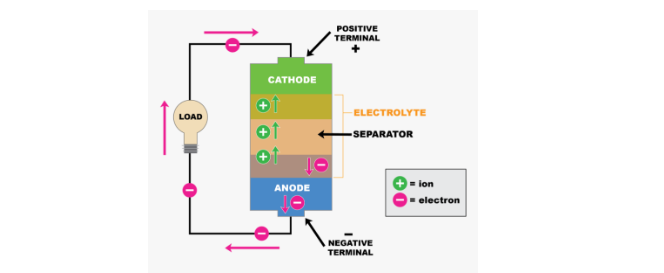
(Schematic diagram of battery)
A battery works by converting chemical energy into electrical energy through the oxidation and reduction reactions of an electrolyte with metal. A typical battery consists of two electrodes (say, copper and zinc) and an electrolyte (say, sulphuric acid). When the electrodes are put inside the electrolyte, electron flows from one electrode to the other and this causes flow of current when the two electrodes are connected by a wire outside.
Maharishi Agastya
Maharishi Agastya was one of the seven Vedic rishis and was the elder brother of Maharishi Vashishtha, the clan guru of King Dasharatha of Ayodhya. Maharshi Agastya is the seer of many mantras of the Rigveda and made pioneering contributions in the field of Ayurveda and Jyotisha shastra. He is also the seer of power-packed hymns in praise of Suryadeva (Aditya Hridayam Stotram) and Mata Saraswati (Saraswati Stotram). He is considered as the Father of Tamil literature. Prabhu Shri Rama stayed at Maharshi Agastya’s ashram during his exile. The Sage gave Him three gifts: a bow made by Vishwakarma, an inexhaustible quiver, and a sword.
Agastya Samhita
Long before the invention of battery by Volta, use of battery and electricity is found in an ancient Hindu treatise. It is Agastya Samhita written by revered Vedic sage Maharishi Agastya. He composed ‘Agastya Samhita’ which has been discussed in Vedas, Puranas, Valmiki Ramayana, Bhagavad Gita etc. The 3000-year-old book Agastya Samhita includes kites, balloons, aeroplanes, ayurveda, astrology. Martial arts and electricity. Here, his writings on electricity have been discussed.
Method of Producing Electricity
Maharishi Agastya has written the method for producing electricity in the following slokas:
संस्थाप्य मृण्मये पात्रे ताम्रपत्रं सुसंस्कृतम्।
छादयेच्छिखिग्रीवेन चार्दाभि: काष्ठापांसुभि:॥
दस्तालोष्टो निधात्वय: पारदाच्छादितस्तत:।
संयोगाज्जायते तेजो मित्रावरुणसंज्ञितम्॥
: “Sansthapya Mrinmaya Patre Tamrapatram Susanskritam,
Chhadyechhikhigriven Chardrarbhih Kashthpamsubhih.
Dastaloshto Nidhatavyah Pardachhaditastah,
Sanyogajjayte Tejo Mitravarunsangyitam.”
Meaning:
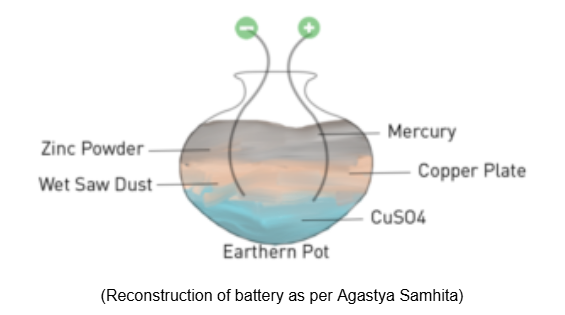
“Place a well-cleaned copper plate in an earthenware vessel. Cover it first by copper sulphate and then by moist sawdust. After that, put a mercury-amalgamated zinc sheet on top of the sawdust to avoid polarization. The contact will produce an energy known by the twin name of Mitra-Varuna.”
In fact, this is the same principle as the modern battery works. Raosaheb Krishnaji Bajhe discovered the writings on battery in Agastya Samhita. After graduating in engineering from Pune, he searched for Indian science in ancient books. During this time, he found some pages of Agastya Samhita with Damodar Tryambak Joshi of Varanasi. He gave it to Dr M. C. Sahastrabuddhe, head of the Department of Sanskrit, Nagpur University. Dr Sahastrabuddhe found there the description of a battery whose working principle seemed the same as that of the modern-day Daniel battery. He gave it to P. P. Hole, Professor of engineering, Nagpur to examine it.
- P. Hole and one of his friends tried to construct an equipment according to the description given in Agastya Samhita. However, they could not understand one item described in the sloka. The item was ‘sikhigriba’. From the Sanskrit dictionary they understood its meaning as ‘neck of peacock’. So, they went to the zoo of Maharaja and asked the manager, “When will a peacock in your zoo die?” The manager became very angry, became calm after listening to their purpose. He told them to write an application for this.
Professor Hole and his friend, while discussing with an Ayurvedic scholar, asked him about ‘sikhigriba’. The Ayurvedic scholar laughed and said, “here it is not meant for the neck of a peacock, but a substance of that colour. This substance is copper sulphate.” Then, Professor Hole constructed a battery taking all the materials described in the book. From this he got 1.38 volt electricity and when he joined the two terminals of the battery with a wire there was flow of 23 milliampere of current through it.
The success of the experiment was conveyed to Dr Sahastrabuddhe. He demonstrated it at the fourth annual convention of Swadeshi Vigyan Samvidhan Sansthan, Nagpur on 7th august 1990. After that it was believed and accepted that the equipment described in Agastya Samhita was actually a battery.
As per Agastya Samhita, Maharishi Agastya used the following materials:
- Earthen pot
- Wet sawdust
- Zinc powder
- Copper plate
- Copper sulphate
Utilisation of Electricity
Not only is the method of electricity generation described in Agastya Samhita, there is also written about its utilisation.
- Dissolution of Water
There is a sloka which describes how to dissociate water with electricity. The sloke is:
अनने जलभंगोस्ति प्राणोदानेषु वायुषु।
एवं शतानां कुंभानांसंयोगकार्यकृत्स्मृत:॥
“Anne Jalabhangosti Pranodaneshu Vayushu.
And Shatanam Kumbhaana Sanyoga Karyakritsmrita:॥“
Meaning:
If we will put energy in water, then this will lead to the disintegration of water into Praana vaayu (life-giving oxygen) and Udaana vaayu (floating hydrogen). A chain of one hundred such jars is said to give a very active and effective force.
He further writes,
वायुबन्धकवस्त्रेण निबद्धो यानमस्तके
उदान स्वलघुत्वे बिभर्त्याकाशयानकम्।
“Vayubandhakvastren Nibaddho Yanmastake
Udanah Swalaghutve Bibhartyakashayanakam.”
If hydrogen is contained in an air tight cloth, it can be used in aerodynamics, i.e. it will fly in air. (Today’s Hydrogen Balloon)
Electroplating
Maharishi Agastya has also written about electroplating. The sloka is:
कृत्रिमस्वर्णरजतलेप: सत्कृतिरुच्यते।
यवक्षारमयोधानौ सुशक्तजलसन्निधो॥
आच्छादयति तत्ताम्रंस्वर्णेन रजतेन वा।
सुवर्णलिप्तं तत्ताम्रं शातकुंभमिति स्मृतम्॥
“Krutrimswarnarajatlep: Satkritiruchyate।
Yavaksharamyodhanaou sushkatjalsannidho॥
Achchhadayati Tattamramswarnen Rajaten Va।
Suvarnaliptam Tattamram Shatakumbhmiti Smritam ॥“
Meaning:
Coating of metal like gold or silver is called Satkriti. As soon as strong water (acid solution) comes in contact with the iron vessel, the alkali (gold or silver nitrate) covers the copper with gold or silver. That copper coated with gold is called Shatkumbh or gold.
Electric Wire
In the text, there is a description of electric wires to carry current. This was called rope. One sloke tells,
नवभिस्तस्न्नुभिः सूत्रं सूत्रैस्तु नवभिर्गुणः।
गुर्णैस्तु नवभिपाशो रश्मिस्तैर्नवभिर्भवेत्।
नवाष्टसप्तषड् संख्ये रश्मिभिर्रज्जवः स्मृताः।।
“Navabhistasnnubhi sutram sutraistu navabhirgunah.
Gurnaistu Navabhipasho Rashmistarnavbhirbhavet.
Navashtasptashad number rashmibhirrajjavah smritaah.”
Meaning:
A formula of 9 stars is formed. One guna of 9 threads, one loop of 9 gunas, one ray from 9 loops and 9, 8, 7 or 6 rope rays, all this when mixed together forms a rope (electric wire).
Different Types of Electricity
Rao Saheb Vajhe, who spent his life in rummaging the Indian scientific scriptures, and discovering various experiments, gave different names to electricity on the basis of the Agastya Samhita and other scriptures and that electricity is created in different ways. Ancient Vedic technologists produced six kinds of electricity:
- Tadit—the one produced by friction from leather or silk,
- Saudamini—that produced by friction from gems or glass,
- Vidyut—produced from clouds or steam,
- Shatakoti alias Shatakumbhi—that produced from a battery of hundreds of cells,
- Hradini—that obtained from storage cells,
- Ashani—the one emanating from a magnetic rod.
Conclusion
The importance of Agastya Samhita can be ascertained from an excerpt from “Technology of the Gods: The Incredible Sciences of the Ancients” – By David Hatcher Childress. “In the temple of Trivandrum, Travancore, the Reverned S. Mateer of the London Protestant Mission saw ‘a great lamp which was lit over one hundred and twenty years ago’, in a deep well inside the temple. On the background of the Agastya Samhita text’s giving precise directions for constructing electrical batteries, this speculation is not extravagant.”
From the above discussion, it is clear that electricity was known in India about 3000 years back and it was being used for electroplating. Maharishi Agastya was the first person in the world to create an electric battery and he was using it for electroplating and other purposes. It must be told to today’s students so that they can visualise our ancient wisdom.
Reference
- Agastya Samhita – Sudhakar Malviye – Chowkhamba Sanskrit Series, Varanasi (2023).
- “Technology of the Gods: The Incredible Sciences of the Ancients” – By David Hatcher Childress – Adventures Unlimited Press, USA (20000).
- http://cpdarshi.wordpress.com/2012/04/28/proof-of-electric-battery-in-agastya-sanhita.
- https://www.mahakavya.com/formula-for-electric-battery-in-agastya-samhita.
- https://www.themysteriousindia.net/electricity-in-ancient-india.