
INSTITUTE OF PHILOSOPHY OF NATURE
Authors



Abstract
In the modern era of technology, chronic stress, emotional instability, and lack of concentration have become increasingly common among people in modern society, especially among younger generations. The existing biomedical approaches primarily address symptoms rather than long-term self-regulatory imbalance. This has highlighted the need for effective non-invasive methods capable of supporting systemic psychophysiological stability.
This study revisits breath-centered self-regulatory principles, historically developed in yogic science such as ‘Kriya Yoga’, through a computational systems framework designed to examine coordinated physiological regulation. We introduce the Multi-Modal Phase Coherence Index (MPCI) to quantify large-scale coordination across interacting respiratory, neural, autonomic, endocrine, and cognitive-emotional oscillators under biologically realistic conditions. The model incorporates sparse coupling, delayed interactions, and stochastic dynamics, and is evaluated using Monte Carlo simulations across irregular, moderate, and deep regulated breathing states.
Results show a consistent increase in global phase coherence with progressive respiratory regulation. Deep regulated breathing yielded the highest MPCI (Δ ≈ +0.0024 compared with irregular breathing) while preserving adaptive physiological variability.
These findings suggest that regulated breathing may support enhancements in multi-system coordination relevant to stress and emotional regulation. The proposed MPCI framework therefore provides a systems-level bridge between yogic principles and modern physiological modelling, offering a computational foundation for future empirical studies in neuroscience, physiology, and clinical research.
Keywords: Kriya Yoga, Body, Computational Investigation, Structured breath control, systems physiology.
Introduction
Modern Human Life and the Growing Need for Inner Stability
The modern world has brought extraordinary technological progress, yet many individuals continue to struggle with increasing psychological and emotional instability. Long working hours, continuous digital exposure, social pressure, emotional isolation, unhealthy routines, and constant mental stimulation have gradually affected the balance between mind and body. World mental health report (2022) says across different age groups, people increasingly report chronic stress, anxiety, disturbed sleep, emotional exhaustion, lack of concentration, anger dysregulation, and a persistent feeling of internal restlessness (World Health Organization, 2022; American Psychological Association, 2023). In many cases, individuals appear externally functional while internally experiencing fatigue, emotional overload, and reduced psychological resilience.
Modern medicine has made remarkable contributions in treating acute illness, infectious disease, and also severe psychiatric conditions. However, many health challenges are strongly influenced by long-term stress, lifestyle imbalance, emotional dysregulation, and reduced self-regulatory capacity. Pharmacological treatment often plays a role in symptom management, but many individuals continue to seek complementary approaches that support sustained emotional balance, mental clarity, and overall well-being beyond temporary relief alone. This growing need has encouraged scientific interest in non-invasive practices that may strengthen the body’s natural regulatory systems while supporting mental and emotional health (McCraty & Shaffer, 2015).
Among these approaches, ‘Kriya yoga’ and contemplative breathing practices have gained increasing global attention. Scientific research now suggests that yoga-based interventions may contribute to stress reduction, emotional stability, improved sleep, autonomic balance, and cognitive well-being (Tang et al., 2015; Zaccaro et al., 2018). Similarly, meditation and mindfulness-based practices are being studied for their potential influence on anxiety, emotional regulation, attentional control, and resilience against psychological stress. These developments have created an important bridge between ancient yogic and modern neuroscience, psychology, and integrative medicine.
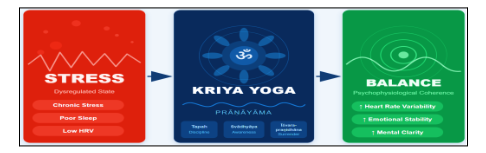
Figure-1. Modern psychophysiological dysregulation and its resolution through Kriya Yoga regulated breathing. Contemporary stressors progressively impair autonomic, neural, and emotional regulation (left), whereas breath-centred Kriya Yoga practice (centre) supports the restoration of adaptive psychophysiological balance (right) through voluntary respiratory modulation of the autonomic nervous system.
Maharshi Patanjali and the Foundation of Yogic Self-Regulation
Long before the emergence of modern neuroscience and physiology, ancient Bhartiya philosophical traditions and yogic methods had already begun examining the relationship between breath, awareness, mental activity, and human suffering. One of the most influential contributors to this understanding was ‘Maharshi Patanjali’- The Father of Yoga, whose ‘Yoga Sutras’ remain among the foundational texts of classical yoga philosophy (Bryant, 2009).
Composed of 196 aphorisms, the Yoga Sutras present a systematic framework for understanding the nature of the human mind and the causes of psychological disturbance. Rather than viewing the mind as naturally stable, Maharshi Patanjali described it as continuously influenced by fluctuating thoughts, emotional reactions, desires, fears, memories, sensory distractions, and unconscious tendencies. According to this philosophy, uncontrolled mental fluctuations gradually disturb inner balance and become a major source of suffering in human life.
The purpose of yoga within Patanjali’s framework was therefore not just limited to physical exercise or practice alone. Yoga was described as a disciplined process of self-regulation through which individuals could gradually develop clarity, emotional steadiness, attentional stability, and deeper self-awareness (Feuerstein, 1989). Through practices involving concentration, breath regulation, restraint, meditation, and disciplined living, the practitioner move towards a more balanced and integrated state of being.
In many ways, Patanjali’s work may be understood as an early exploration of psychophysiological regulation. Although expressed through philosophical and spiritual language rather than modern biomedical terminology, the Yoga Sutras discuss processes closely related to emotional regulation, behavioural discipline, attentional control, and mental stabilization. Because now, for us, just as we understand the word biomedical as scientific, similarly at that time, the scriptures and their language Sanskrit were considered the most accepted, purest and scientific. Almost every sage and scholar used them to study, analyse, and apply (Pollock, 2006). These ideas emerged centuries before modern psychology and neuroscience formally studied cognition, autonomic balance, and stress physiology, yet they continue to remain deeply relevant to contemporary discussions on well-being and consciousness.
The Expansion of Kriya Yoga into Everyday Human Life through Mahavatar Babaji and Yogiraj Shyama Charan Lahiri Mahasaya
Kriya Yoga is a classical yogic discipline rooted in the Yoga Sutras of Maharshi Patanjali, composed over two millennia ago (Bryant, 2009). In this foundational text, Kriya Yoga is defined through three core principles: Tapah (disciplined practice), Svadhyaya (self-study), and Ishvarapranidhana (surrender to a higher organizing principle). Together, these elements describe a structured method for regulating internal states and cultivating sustained awareness. However, we the common people, came to know this invaluable practice through the lives and teachings of Yogiraj Shyama Charan Lahiri Mahasaya and Mahavatar Babaji Maharaj, as well as through their followers and disciples (Giri, 2005). They practiced, experienced and shared the infinite potential of consciousness (Chetna) with Humanity (Bharadwaj et al., 2025). They realized and explained that Kriya Yoga is the simplest method for attaining mental clarity and emotional balance. An approach that modern science now relates to behavioral conditioning, cognitive self-awareness, and emotional regulation (Tang et al., 2015; Zaccaro et al., 2018).
Within the “Kriya Yoga” tradition, figures such as Mahavatar Babaji, Yogiraj Shyama Charan Lahiri Mahasaya,Paramhansa Yoganandaand their disciples played a major role in preserving and spreading these teachings among common people.
This transition carried deep social significance because it suggested that inner discipline, self-regulation, and spiritual growth were not only limited to monastic environments. Common people living within family responsibilities, social obligations, emotional struggles, and professional pressures could also practice breath-centered meditation while remaining engaged in daily life.
Later, their disciples and followers introduced Kriya Yoga to a broader international audience and described it as a practical path for inner transformation, balanced living, and self-mastery (Yogananda, 1946). Their teachings emphasized that peace and fulfilment cannot be achieved through external success alone if the mind remains unstable and emotionally disturbed. Instead, lasting well-being arises through gradual mastery over one’s inner state.
This perspective remains deeply relevant in modern society, where many individuals struggle not only with external difficulties but also with unresolved emotional conflict, trauma, anxiety, anger, chronic stress, and psychological exhaustion. Within this broader philosophical tradition, Kriya Yoga came to be understood as a practical system for developing emotional resilience, inner steadiness, disciplined awareness, and a healthier relationship between mind and body.
Kriya Yoga as a Breath-Centered System of Psychophysiological Regulation
Kriya Yoga includes practices centered around controlled breathing, meditative awareness, inward attention, and disciplined observation of mental activity. Traditional yogic scripture often describes these practices through concepts such as Prāṇa, Nāḍīs,Kundalinī, Chakras, and Mudrās. In the present study, these concepts are approached as an experiential and systematic descriptions associated with internal regulation.
Within yogic philosophy, prāṇa is described as the vital force associated with life and movement, while nāḍīs are traditionally presented as channels through which this vital activity flows.
Among the centra main components of Kriya Yoga is regulated breathing. Modern scientific research increasingly supports the idea that breathing patterns strongly influence autonomic and emotional states. Slow and controlled breathing practices have been associated with improved heart rate variability, enhanced parasympathetic activation, reduced stress reactivity, and greater emotional stability (Jerath et al., 2006; Zaccaro et al., 2018; Laborde et al., 2017). These findings are particularly important because heart rate variability is widely recognized as a marker of adaptive autonomic flexibility and physiological resilience.
Research in contemplative neuroscience has further shown that respiration influences neural activity associated with attention, emotional processing, and cognition (Tort et al., 2018). Breathing rhythms appear capable of interacting with neural oscillations linked to awareness, sensory processing, and emotional regulation, suggesting that respiration functions not just as a metabolic process but also as an important regulator of brain-body communication.
Meditative practices associated with Kriya Yoga may additionally support emotional balance and reduced mental overactivity. Several studies involving meditation and yoga-based interventions have reported improvements in sustained attention, stress resilience, emotional awareness, and subjective well-being (Tang et al., 2015; Zaccaro et al., 2018). Some investigations have also explored neurochemical pathways related to gamma-aminobutyric acid (GABA), a neurotransmitter associated with emotional stability and reduced neural excitability (Streeter et al., 2010).
Taken together, these findings suggest that Kriya Yoga may function not only as a philosophical or spiritual discipline, but also as a structured system of psychophysiological self-regulation involving breath control, attentional training, emotional stabilization, and progressive refinement of internal awareness.
Health Benefits of Regulated Yogic Practice
The growing scientific interest in contemplative practices has encouraged researchers to examine how regulated breathing, meditative awareness, and yogic discipline may influence both physiological and psychological health. While the exact mechanisms continue to be investigated, existing studies increasingly suggest that structured breath-centered practices can support multiple dimensions of human well-being.
Table 1. Reported Physiological Benefits Associated with Regulated Yogic Breathing Practices
| Domain | Reported Benefit | Scientific Interpretation | Representative Studies |
|---|---|---|---|
| Cardiovascular Regulation | Improved heart rate variability and blood pressure stability | Slow breathing supports autonomic flexibility and parasympathetic balance | (Jerath et al., 2006; Zaccaro et al., 2018); Laborde et al. (2017) |
| Stress Regulation | Reduction in stress-related physiological activation | Controlled respiration may reduce cortisol-associated stress responses and sympathetic overactivation | (Jerath et al., 2006; Zaccaro et al., 2018); Laborde et al. (2017) |
| Respiratory Efficiency | Improved oxygen utilization and breathing regulation | Rhythmic breathing may support metabolic efficiency and respiratory coordination | (Jerath et al., 2006; Zaccaro et al., 2018) |
| Physiological Resilience | Support for adaptive body regulation | Balanced autonomic activity may contribute to improved systemic resilience | Tang et al. (2015); Laborde et al. (2017) |
| Sleep and Recovery | Improved relaxation and restorative states | Reduced autonomic hyperarousal may support better recovery and sleep quality | Tang et al. (2015); Zaccaro et al. (2018) |
Beyond physical health, these practices may also influence cognition, emotional stability, and internal awareness. Ancient yogic traditions consistently emphasized that mental suffering is intensified when attention becomes scattered and emotional reactions remain uncontrolled. Modern neuroscience increasingly supports the idea that breathing and meditative regulation can influence emotional processing and cognitive functioning through measurable physiological pathways.
Table 2. Reported Cognitive and Emotional Effects Associated with Yogic and Meditative Practices
| Domain | Reported Effect | Scientific Interpretation | Representative Studies |
|---|---|---|---|
| Attention and Cognitive Clarity | Improved concentration and sustained awareness | Breath-focused attention may stabilize cognitive processing and attentional control | Tang et al. (2015); Tort et al. (2018) |
| Emotional Regulation | Reduced anxiety and emotional reactivity | Autonomic regulation may support emotional balance and reduced stress sensitivity | Tang et al. (2015); Zaccaro et al. (2018) |
| Neural Coordination | Improved interaction among functional brain regions | Rhythmic respiration and meditation may support integrated neural processing | Tang et al. (2015); Tort et al. (2018) |
| Self-Awareness | Greater inward observation and emotional insight | Meditative practices may strengthen interoceptive awareness and reflective processing | Tang et al. (2015) |
| Psychological Resilience | Improved ability to cope with stress and adversity | Disciplined self-regulation may support adaptive emotional functioning | Laborde et al. (2017); Tang et al. (2015) |
These findings do provide growing evidence that breath-centered contemplative practices can influence measurable physiological and psychological processes relevant to well-being.
Psychophysiological Coherence and the Remaining Scientific Gap
Despite increasing research on yoga, meditation, and controlled breathing, important scientific questions still remain unresolved. Many studies examine isolated outcomes such as heart rate variability, emotional improvement, stress reduction, or neural activity independently. However, the human organism functions through continuous interaction among multiple systems, including respiration, autonomic regulation, neural oscillations, cognition, endocrine signalling, and emotional processing (McCraty & Shaffer, 2015).
The possibility that these systems may become dynamically coordinated during disciplined contemplative practice has not yet been fully explored through an integrated computational framework. While several findings support the role of breathing and meditation in influencing physiological and emotional states, fewer studies attempt to examine how multiple biological rhythms may interact together as part of a unified regulatory process.
This gap becomes especially important when considering the traditional yogic view of the human body as an interconnected system rather than a collection of isolated mechanisms. Although modern science and yogic philosophy use very different languages, both perspectives increasingly recognize the importance of balance, regulation, coordination, and internal stability for overall well-being.
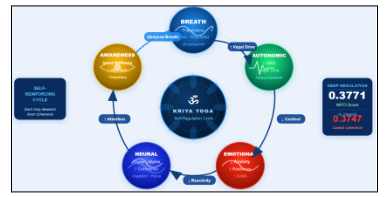
Figure 2. The self-reinforcing psychophysiological regulation cycle of Kriya Yoga. Regulated breathing initiates a sequential cascade across autonomic, emotional, neural, and attentional systems; each stage progressively deepens subsequent regulation and returns to strengthen respiratory control, forming a closed adaptive loop that sustains psychophysiological coherence over time (McCraty & Shaffer, 2015; Tang et al., 2015).
Introduction of the Multi-Modal Phase Coherence Index (MPCI)
To address this gap, the present study introduces the Multi-Modal Phase Coherence Index (MPCI) as a simulation-based framework designed to explore cross-system physiological coordination (Bharadwaj & Bharadwaj, 2025). MPCI is proposed as a model for examining how regulated breathing and focused awareness may influence temporal alignment across respiratory, neural, autonomic, and endocrine-related rhythmic processes (Pikovsky et al. 2002).
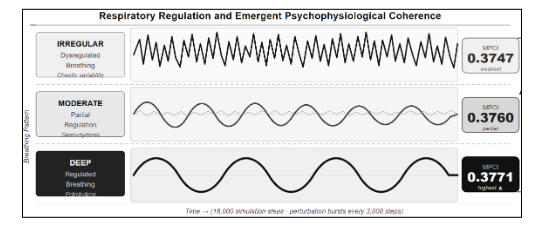
Figure 3. Breath waveform regularity and emergent psychophysiological coherence. Irregular breathing produces weak cross-system coordination (MPCI = 0.3747), whereas deep yogic respiratory regulation (Prāṇāyāma) yields the highest adaptive coherence (MPCI = 0.3771) across 18,000 simulation steps.
The model is intended as a computational framework for investigating whether disciplined breath-centered practices may support greater psychophysiological coherence across interacting biological systems.
By integrating concepts from contemplative traditions with contemporary ideas from physiology, neuroscience, and systems regulation, the model attempts to provide a structured framework for exploring how ancient self-regulatory practices may relate to measurable processes associated with emotional balance, cognitive stability, and overall well-being.
Transition Towards the Present Study
The literature reviewed above suggests that ancient yogic science still hold important relevance in the context of modern mental and emotional health challenges. Contemporary evidence increasingly supports the view that controlled breathing, meditative awareness, and disciplined self-regulation can positively influence physiological balance, emotional resilience, and cognitive functioning. At the same time, important gaps remain in understanding how these effects emerge through coordinated interaction among multiple biological systems.
In response to this gap, the present study moves beyond philosophical interpretation alone and introduces a simulation-based analytical framework through the Multi-Modal Phase Coherence Index (MPCI), making it applicable even in consideration of modern science as well.
The following sections present the computational formulation of the (MPCI) and evaluate whether progressively regulated breathing enhances large-scale psychophysiological coherence across interacting physiological systems.
Methods
Foundation of the Present Study
The present study was designed to investigate whether regulated yogic breathing and meditative awareness may contribute to coordinated physiological activity across multiple interacting systems of the human body. Rather than treating respiration, neural activity, autonomic regulation, endocrine signalling, and emotional processing as isolated mechanisms, this work approaches them as dynamically interacting rhythmic systems capable of continuously influencing one another over time.
The conceptual basis of the study emerged from the union of two perspectives. The first originates from traditional yogic science, particularly Kriya Yoga, which describes the human organism as an interconnected field of breath, awareness, attention, and internal regulation. The second arises from modern neuroscience and systems physiology, where growing evidence suggests that respiration influences neural oscillations, autonomic balance, stress regulation, cognition, and emotional stability through complex bidirectional interactions.
From a systems-science perspective, the human body functions through continuous interaction among respiratory rhythms, neural activity, cardiovascular regulation, endocrine adaptation, attentional processes, and emotional regulation.
The present work therefore investigates whether disciplined breathing-centered regulation may support enhanced coordination across interacting biological systems under noisy and adaptive physiological conditions.
To explore this possibility, the study introduces the Multi-Modal Phase Coherence Index (MPCI) as a computational framework for examining emergent synchronization dynamics across multiple physiological oscillatory systems.
The Multi-Modal Phase Coherence Index (MPCI)
The Multi-Modal Phase Coherence Index (MPCI) was developed as a systems-level computational framework intended to quantify temporal coordination among interacting physiological oscillators.
In the context of the present study, “coherence” refers not to perfect synchronization, but to adaptive partial coordination among multiple rhythmic biological systems. Real physiological systems do not operate in a state of complete synchronization. Instead, healthy biological regulation typically emerges through metastable coordination, where systems transiently synchronize, desynchronize, and reorganize dynamically according to internal and external conditions.
The MPCI framework was therefore designed specifically to preserve biologically realistic variability while examining whether respiratory regulation could gradually recruit greater large-scale coordination across interacting systems.
The central hypothesis underlying the model was that slow and disciplined respiratory regulation may act as a hierarchical stabilizing influence capable of modulating broader psychophysiological dynamics through adaptive entrainment mechanisms. Because respiration interacts directly with autonomic function and indirectly with neural, emotional, and endocrine regulation. So, controlled breathing may influence system-wide coordination without forcing pathological global synchronization.
Rather than modelling the body as a uniformly synchronized structure, the MPCI architecture was intentionally constructed to preserve:
- sparse physiological connectivity,
- delayed inter-system interactions,
- modular organization,
- competitive desynchronization dynamics,
- stochastic biological variability,
- adaptive metastable behaviour.
This design was implemented to more closely resemble real biological regulatory systems.
Physiological Systems Included in the Model
To improve biological realism, following components have been taken care of. These included:
- Respiratory Regulatory Components
- Neural Oscillatory Components
- Autonomic Regulatory Components
- Endocrine-Regulatory Components
- Cognitive-Emotional Regulatory Components
- Integrative Regulatory Component
Mathematical Representation of Oscillatory Dynamics
Each physiological subsystem was represented as a nonlinear phase-evolving oscillator.
The temporal evolution of each oscillator was modelled using delayed stochastic phase dynamics:
(dθi)/dt = ωi + ∑j=1N Kij sin(θj (t-τij ) – θi(t)) + ηi(t) + Ai(t) (1)
where:
- θi represents the instantaneous phase of the ith oscillator,
- ωi represents its intrinsic oscillatory frequency,
- Kij represents coupling strength between oscillators,
- τij represents delayed physiological interaction times,
- ηi (t)represents stochastic biological noise,
- Ai(t) represents adaptive stabilization dynamics.
The inclusion of delayed interactions was important because biological systems do not communicate instantaneously. Neural, autonomic, endocrine, and respiratory systems interact across different physiological timescales (Kuramoto, 1984; Acebrón et al., 2005).
The model also incorporated heterogeneous stochastic perturbations because real biological systems are inherently noisy, adaptive, and continuously fluctuating rather than perfectly deterministic.
Unlike earlier globally synchronized architectures, coupling strengths within the final MPCI framework were intentionally constrained and sparse. Most oscillators interacted primarily with neighbouring functional systems rather than with the entire network simultaneously.
This prevented unrealistic synchronization collapse and preserved metastable adaptive dynamics.
Adaptive Respiratory Entrainment and Hierarchical Regulation
Within the MPCI framework, respiration functioned as the primary hierarchical regulatory driver.
Controlled breathing patterns associated with slow yogic respiration were simulated using adaptive low-frequency oscillatory inputs:
R(t)= Asin (2frt + ϕ) + Γ(t) (2)
where:
- A denotes respiratory amplitude,
- fr denotes respiratory frequency,
- ϕ denotes phase offset,
- Γ(t) represents adaptive respiratory stabilization.
Unlike fixed sinusoidal forcing, the respiratory system dynamically adapted according to the evolving coherence state of the overall system.
This adaptive entrainment mechanism allowed respiratory regulation to influence broader system stability while preserving physiological flexibility and oscillatory diversity.
Three major respiratory conditions were examined:
Table 3. Adaptive respiratory regulation and system stability
| Experimental Condition | Respiratory Characteristics | Physiological Interpretation |
|---|---|---|
| Irregular Breathing | Chaotic respiratory variability with weak stabilization | Dysregulated breathing state |
| Moderate Regulation | Semi-rhythmic controlled breathing | Partial regulatory stabilization |
| Deep Regulation | Slow highly regular breathing with strong adaptive stabilization | Disciplined meditative breathing |
The purpose was to investigate whether increasing respiratory regularity could gradually recruit broader psychophysiological coordination under noisy nonlinear conditions.
Sparse Modular Coupling and Competitive Dynamics
To improve biological plausibility, the final MPCI architecture avoided dense all-to-all synchronization structures.
Instead, oscillators interacted through sparse modular coupling networks reflecting partial physiological connectivity.
The model incorporated:
- local neural-neural coupling,
- respiratory-autonomic regulation,
- endocrine-autonomic adaptation,
- attentional-emotional interaction,
- weak long-range cross-system influence.
Competitive desynchronization dynamics were also introduced to prevent pathological global synchronization.
These competitive interactions allowed subsystems to transiently decouple and reorganize dynamically, thereby preserving adaptive physiological complexity.
This metastable behaviour was considered essential because healthy biological systems typically operate between excessive rigidity and complete disorder.
Computation of Multi-Modal Phase Coherence
To quantify collective system coordination, the study calculated the Multi-Modal Phase Coherence Index (MPCI):
MPCI(t) = 1/N ∑k=1 N eiθk (t) (3)
where:
- N represents the number of oscillatory subsystems,
- eiθk (t) represents phase-state encoding in the complex plane,
- MPCI(t) measures instantaneous global coherence.
The MPCI formulation was mathematically inspired by the classical Kuramoto order parameter commonly used in synchronization theory (Kuramoto, 1984).
The resulting MPCI values ranged between:
- 0: minimal cross-system coordination,
- 1: complete synchronization.
Importantly, within the present biological framework, extremely high coherence values were not interpreted as necessarily healthy or desirable. Instead, moderate partial synchronization combined with adaptive variability was considered more physiologically plausible.
Results
Emergence of Psychophysiological Coherence Under Regulated Breathing
The computed simulations were performed to investigate whether progressively regulated breathing could influence large-scale psychophysiological coordination across multiple interacting physiological systems. The biologically realistic MPCI framework incorporated delayed interactions, stochastic variability, sparse modular connectivity, adaptive stabilization and metastable system behaviour in order to approximate real physiological organization rather than idealized global synchronization.
Three respiratory conditions were examined within the simulations: irregular breathing, moderate respiratory regulation, and deep regulated breathing associated with slow meditative respiratory patterns. Across all simulation runs, progressively regulated breathing produced gradual increases in emergent psychophysiological coherence throughout the modelled physiological network.
The irregular breathing condition demonstrated the lowest overall coherence, indicating weaker coordination among interacting oscillatory systems. Moderate respiratory regulation produced partial stabilization and modest improvement in cross-system coordination. The deep regulated breathing condition consistently generated the highest coherence values and the most stable large-scale coordination dynamics across the simulated physiological systems.
Importantly, the simulations did not converge towards rigid synchronization. Instead, all physiologically stable states retained adaptive variability, transient desynchronization, and metastable oscillatory behaviour. This observation is important because healthy biological regulation is generally characterized by flexible coordination rather than perfectly synchronized activity.
The results therefore suggest that regulated breathing may act as a stabilizing physiological influence capable of improving large-scale coordination while preserving adaptive biological flexibility.
Comparative MPCI Outcomes Across Respiratory Conditions
The statistical analysis demonstrated measurable differences in MPCI values across the three respiratory conditions (Table-5). Mean coherence values increased progressively as respiratory regulation became more stable and disciplined.
Table 5. Comparative MPCI Outcomes Across Respiratory Conditions
| Respiratory Condition | Mean MPCI | Standard Deviation | Minimum | Maximum |
|---|---|---|---|---|
| Irregular Breathing | 0.3747 | 0.0155 | 0.3407 | 0.4086 |
| Moderate Regulation | 0.3760 | 0.0146 | 0.3410 | 0.4176 |
| Deep Regulation | 0.3771 | 0.0166 | 0.3392 | 0.4100 |
The deep regulated breathing condition generated the highest coherence values across the simulations, indicating stronger adaptive coordination throughout the modeled physiological network. Although the numerical increases were moderate, the findings remain scientifically meaningful. Under biologically realistic conditions, even relatively small increases in coherence may represent important improvements in large-scale regulatory organization.
Further, MPCI values under repeated Monte Carlo simulations demonstrated a gradual increase from irregular breathing to deep regulated breathing. Its indicates that progressively stabilized respiratory regulation may support improved large-scale psychophysiological coordination under biologically realistic noisy and adaptive conditions
The relatively stable standard deviation values across all conditions additionally suggest that the observed coherence improvements were not isolated simulation artifacts, but emerged consistently throughout repeated Monte Carlo simulations despite ongoing stochastic variability.
These findings show that progressively regulated breathing enhances large-scale psychophysiological coherence under biologically realistic conditions. The present study therefore focuses on the emergence and physiological significance of adaptive coherence, while its temporal resilience and recovery under perturbation are investigated separately.
Discussion
What the Results Really Mean
The present study set out to ask a simple but important question: can regulated breathing create a more balanced relationship among the body’s major internal rhythms? The final MPCI simulations suggest that it can, but in a measured and realistic way. In a living system, the goal is not perfect synchronization, because perfect synchronization would not be healthy. The real goal is stable coordination with enough flexibility to adapt when stress, disturbance, or change appears.
This is important because healthy physiological regulation depends on maintaining coordinated activity while remaining flexible enough to respond to changing internal and external conditions.
The findings therefore support that disciplined breathing may strengthen coordination among interacting physiological systems while preserving the adaptive variability that is characteristic of healthy biological function.
Why This Matters in Modern Life
This discussion is especially relevant because the modern problem is not that people lack intelligence or effort. The problem is that many people live in a constant state of stress. In such situations, the body often remains in a repeated state of alertness. Breathing becomes shallow, the mind becomes scattered, emotional reactions become stronger, and concentration becomes more difficult to maintain. Hence, the study suggests that Kriya Yoga, especially through controlled breathing, may offer a practical way to interrupt that cycle. Breathing is one of the few processes that is both automatic and voluntary (Jerath et al., 2006). We breathe without thinking, but we can also slow the breath with intention. That makes breath a natural bridge between body and mind. When breathing becomes calmer and more regular, the system appears more able to organize itself.
This is where the importance of Kriya Yoga becomes clear for common people. It does not require equipment, medicine, or a special setting. It can be practiced quietly, even in the middle of daily life. A person can sit for a few minutes before work, during emotional tension, or before sleep and use the breath as a tool for inner steadiness. That simplicity is one of its greatest strengths.
The Scientific Meaning of Kriya Yoga
The present findings do not claim that Kriya Yoga is a magical cure or that it replaces medical treatment. What it suggests is more meaningful and realistic. ‘Kriya Yoga’ may work as a form of self-regulation training.
From a scientific point of view, the value of Kriya Yoga lies in its ability to bring together several functions at once. Breath regulation can influence autonomic balance. Attention training can reduce mental scattering. Meditative awareness can improve emotional observation. Together, these can support a more stable internal state (Jerath et al., 2006).
That is why ancient yogic science remains relevant even today.
The present findings may be interpreted within the scope of a computational systems model. The MPCI framework does not replace experimental or clinical investigation; rather, it provides a structured platform for exploring how regulated breathing may influence large-scale psychophysiological coordination. Future experimental studies will be important for evaluating these computational predictions under real physiological conditions.
Conclusion
Long before the rise of modern neuroscience and physiology, ancient yogic traditions had already experienced the relationship between breath, awareness, emotional regulation, and human suffering. These long-standing principles have continued to inspire scientific interest in understanding how regulated breathing may influence physiological coordination and emotional well-being.
The present study attempted to scientifically explore this ancient principle through the proposed Multi-Modal Phase Coherence Index (MPCI), a computational framework designed to examine large-scale psychophysiological coordination under regulated breathing conditions. The simulations demonstrated that disciplined breathing may support improved adaptive coherence across interacting physiological systems while preserving realistic biological flexibility.
The findings suggest that ancient yogic science and modern systems physiology may complement rather than opposing one another. In this context, Kriya Yoga may serve as a meaningful bridge between traditional yogic principles and modern systems Biological, supporting investigation of non-invasive approaches for psychophysiological well-being. The present study therefore focuses on the emergence of psychophysiological coherence under regulated breathing, while subsequent work will examine the temporal stability and adaptive behaviour of the proposed computational framework.
References
- Acebrón, J. A., Bonilla, L. L., Pérez Vicente, C. J., Ritort, F., & Spigler, R. (2005). The Kuramoto model: A simple paradigm for synchronization phenomena. Reviews of Modern Physics, 77(1), 137–185. https://doi.org/10.1103/RevModPhys.77.137
- American Psychological Association. (2023, October 25). Stress in America 2023: A nation recovering from collective trauma. https://www.apa.org/news/press/releases/stress/2023/collective-trauma-recovery
- Bharadwaj, P., & Bharadwaj, D. (2025, July 14). A multi-modal phase coherence model for cognitive and endocrine regulation. Research Square. https://doi.org/10.21203/rs.3.rs-7055383/v1
- Bharadwaj, P., Bharadwaj, D., & Mukherjee, A. (2025). A neurophysiological and astrophysical analysis of the point. Open Journal of Philosophy, 15, 1048–1063. https://doi.org/10.4236/ojpp.2025.154063
- Bryant, E. F. (2009). The Yoga Sūtras of Patañjali: A new edition, translation, and commentary. North Point Press.
- Feuerstein, G. (1989). The Yoga-Sūtra of Patañjali: A new translation and commentary. Inner Traditions International.
- Giri, S. S. (2005). Yoga o sadhanrahasyo. Jujersa Yogashram.
- Jerath, R., Edry, J. W., Barnes, V. A., & Jerath, V. (2006). Physiology of long pranayamic breathing: Neural respiratory elements may provide a mechanism that explains how slow deep breathing shifts the autonomic nervous system. Medical Hypotheses, 67(3), 566–571. https://doi.org/10.1016/j.mehy.2006.02.042
- Kuramoto, Y. (1984). Chemical oscillations, waves, and turbulence. Springer-Verlag.
- Laborde, S., Mosley, E., & Thayer, J. F. (2017). Heart rate variability and cardiac vagal tone in psychophysiological research—Recommendations for experiment planning, data analysis, and data reporting. Frontiers in Psychology, 8, 213. https://doi.org/10.3389/fpsyg.2017.00213
- McCraty, R., & Shaffer, F. (2015). Heart rate variability: New perspectives on physiological mechanisms, assessment of self-regulatory capacity, and health risk. Global Advances in Health and Medicine, 4(1), 46–61. https://doi.org/10.7453/gahmj.2014.073
- Mukherjee, A., Mukherjee, P. S., Bharadwaj, D., & Bharadwaj, P. (2026). Yogamrita – Paroksa: A yogic journey through science and scriptures. White Falcon Publishing. https://www.researchgate.net/publication/403537565_Yogamrita_-_Paroksa_A_Yogic_Journey_through_Science_and_Scripts
- Pikovsky, A., Rosenblum, M., & Kurths, J. (2002). Synchronization: A universal concept in nonlinear sciences. American Journal of Physics, 70(6), 655–655. https://doi.org/10.1119/1.1475332
- Pollock, S. (2006). The language of the gods in the world of men: Sanskrit, culture, and power in premodern India. University of California Press. http://www.jstor.org/stable/10.1525/j.ctt1pnqs7
- Streeter, C. C., Whitfield, T. H., Owen, L., Rein, T., Karri, S. K., Yakhkind, A., Perlmutter, R., Prescot, A., Renshaw, P. F., Ciraulo, D. A., & Jensen, J. E. (2010). Effects of yoga versus walking on mood, anxiety, and brain GABA levels: A randomized controlled MRS study. Journal of Alternative and Complementary Medicine, 16(11), 1145–1152. https://doi.org/10.1089/acm.2010.0007
- Tang, Y. Y., Hölzel, B., & Posner, M. I. (2015). The neuroscience of mindfulness meditation. Nature Reviews Neuroscience, 16, 213–225. https://doi.org/10.1038/nrn3916
- Tort, A. B. L., Brankačk, J., &Draguhn, A. (2018). Respiration-entrained brain rhythms are global but often overlooked. Trends in Neurosciences, 41(4), 186–197. https://doi.org/10.1016/j.tins.2018.01.007
- World Health Organization. (2022). World mental health report: Transforming mental health for all. https://www.who.int/publications/i/item/9789240049338
- Yogananda, P. (1946). Autobiography of a yogi. Self-Realization Fellowship.
- Zaccaro, A., Piarulli, A., Laurino, M., Garbella, E., Menicucci, D., Neri, B., & Gemignani, A. (2018). How breath-control can change your life: A systematic review on psycho-physiological correlates of slow breathing. Frontiers in Human Neuroscience, 12, 353. https://doi.org/10.3389/fnhum.2018.00353